Showing posts with label Miracles. Show all posts

Saturday, November 16, 2013

Does Asking for Signs Evidence a Lack of Faith?

What is your motive when you ask God for a sign?

For some people, they're facing the decision of possibly having to do something that they really do not want to do.
  • Sometimes, this can result in a person asking God for an enormous sign they really don't believe has any chance of happening, because that way they can trick themselves into thinking that God really didn't want them to do it.  But God can perform even the most impossible signs if He wants to, so I believe that in these cases, He doesn't provide the sign because He knows that person is in rebellion against Him, not truly seeking His will.
  • But other times, people facing a decision they emphatically do not want to do ask for a sign because they are seeking God's will deep down, but there is a massive struggle inside of them because of how much they don't want to do it.  They feel God directing them toward a decision, and already know what His answer will be in the sign, but they need that extra push to force them over the edge into saying "Yes" to God.  In a way, their asking for a sign is a great act of faith and sacrifice, because they are asking for something their minds cannot write off as coincidence or misunderstanding - they are asking for a definitive command.

In other cases, asking for a sign is the responsible thing to do!  If we feel that God is pushing us towards a decision, but there is a lot at stake, it can definitely be responsible to ask for a sign so we don't make a mistake by our own emotions and inclinations getting in the way of us truly hearing the Holy Spirit's leading in our souls.  What's at stake may be human lives, a very large amount of money, or a life path (career, marriage, etc.) - and since these "assets" all belong to God, asking for a sign can be just making sure we're not mishandling His possessions!
  • Look at Gideon in Judges 6-7.  He asked for a sign more than once about the same decision because he had 32,000 lives depending on him making the correct choice!  Of course he wanted to make absolutely, positively sure that He was hearing God right!
  • I think the same situation might be what's going on in Isaiah 7 .  Isaiah instructs King Ahaz to ask for a sign so he will know he can trust the important prophecy about war he has just heard - but Ahaz refuses (under the guise of having faith), and is rebuked and cursed for it.  A prophet ordained by God told him to ask for a sign because the prophecy was a really big deal, and it seems to me that the idolatrous king's refusal to ask for one shows that he didn't take God's plan for the war seriously.

Do you have thoughts you'd like to share about any of the circumstances described above, or can you think of another important type of situation involving asking for a sign?  Leave a comment below. :-)

Monday, May 27, 2013

Intensifying Blatancy - Matthew 21:12-22

Scripture Passage #1
 
12 And Jesus entered the temple and drove out all those who were buying and selling in the temple, and overturned the tables of the money changers and the seats of those who were selling doves.
 
13 And He said to them, "It is written, 'MY HOUSE SHALL BE CALLED A HOUSE OF PRAYER'; but you are making it a ROBBERS' DEN."
 
14 And the blind and the lame came to Him in the temple, and He healed them.
 
15 But when the chief priests and the scribes saw the wonderful things He had done, and the children who were shouting in the temple, "Hosanna to the Son of David," they became indignant
 
16 and said to Him, "Do you hear what these children are saying?"  And Jesus said to them, "Yes; have you never read, 'OUT OF THE MOUTH OF INFANTS AND NURSING BABIES YOU HAVE PREPARED PRAISE FOR YOURSELF'?"
 
17 And He left them and went out of the city to Bethany, and spent the night there.
 
The Basics of What's Going On Here
 
This is yet another of my favorite "scenes" in the Bible involving Jesus. :-)  I adore the idea of a warrior God defending the weak from evil, and that is certainly exhibited here.  But another thing I love about this event is that each Gospel seems to emphasize a different aspect of what happened, each on teaching us something unique.  Let's dive in and see what Matthew saw as important in this story.
 
In case you're not very familiar with this story, here's a quick run-down of what was going on:
  • There were very specific rules in the Jewish temple about what kind of money you could use and what quality of animals were okay for sacrifices.  So, moneychangers and animal salesmen set up shop there...which seems very useful at first glance.  But the problem was that they were not there just to help people worship God and make a living - they were swindling the worshipers.
  • The scribes and priests were totally okay with this system - they worked there, too!  It fit perfectly with the hypocritical, hyper-legalistic system they had set up to turn themselves into the "holy" elite.  Someone declaring this temple system to be morally wrong directly threatened them.
So, Jesus came in and caused quite the stink about this situation.  He acted as a one-man riot, overturning tables, scattering money everywhere, letting the animals free, and chasing the swindlers out with a whip.  Imagine if someone came running into your church and threw to contents of the offering bucket all over the floor, overturned the communion stands, and grabbed each of the pastoral staff by their shirt collars and drug them outside...  It was a radical act!
 
This wasn't just wanton destruction...it was an act of cleansing His temple through destruction.  In the Old Testament, when Israel turned to evil and its worship became mere lip-service, God orchestrated events so His temple would be literally turned to rubble - it's the same principle as here.  The message is that hypocrisy reaching all the way to God's own house cannot be tolerated.
 
But Jesus's act was far more than a message of disapproval - Christ also restored the Temple to its true purpose, and that's what I see as Matthew's main emphasis.  Just look at the contrast - the rich and powerful (who were evil in this case) were chased out, and God welcomed the lowest of society (children and the sick, who were viewed as sinful).  The Temple was the place for Jews to commune with God Himself - and they had the opportunity to do that.
 
Deity, Prophecy, and Other Gospels
 
I think the fact that the sick came to Christ for healing after He did this whole rampage-through-the-Temple thing shows that they genuinely believed He was Messiah.  If they didn't, they surely would have thought that He had no right to do what He just did.  I mean, if I had terminal cancer and knew of a renowned prophet who could miraculously heal, and he did some radical religious act like we see in this passage, I wouldn't go to him for healing unless I fully believed he had the God-given authority to do what he did!
 
Even if my assumptions on that are wrong, however, the children were definitely identifying Him as Messiah!  In 2 Samuel 7:12-16, God promised King David that his descendants would ultimately reign forever.  At first, this was an unbroken chain of his son, grandson, great-grandson, etc. serving as king of Israel, and part of the prophecy speaks to that; but in the eternal sense, Christ's throne would reign forever, and Christ was a biological descendant of David (see the genealogy in Matthew 1).  So, a common term referring to the Messiah in Jesus's day was "Son of David."
 
So, the Pharisees noticed that the children were identifying Jesus as the Messiah, and tried to call Him out on not correcting them.  He responded, "Yes," and further declared His deity by quoting another Scripture about God - Psalm 8:2!  Since He intended to let them crucify Him shortly after this, He could be very overt in declaring Himself to be both Messiah and God.
 
If you want to look into the Scriptures Christ referenced in verse 13 of today's passage, they are Isaiah 56:7 and Jeremiah 7:11 (the entirety of Jeremiah 7 is related, so you  may want to check that out if you have time).
 
If you're interested in the other gospels' take on this story:
Mark 11:15-18 - emphasizing how much His radical act caused the priests and scribes to hate Him
Luke 19:45-48 - emphasizing how people responded to His authority
John 2:13-22 (actually an earlier event - Jesus did this twice) - emphasizing His Deity and authority even more
 
Scripture Passage #2
 
18 Now in the morning, when He was returning to the city, He became hungry.
 
19 Seeing a lone fig tree by the road, He came to it and found nothing on it except leaves only; and He said to it, "No longer shall there ever be any fruit from you."  And at once the fig tree withered.
 
20 Seeing this, the disciples were amazed and asked, "How did the fig tree wither all at once?"
 
21 And Jesus answered and said to them, "Truly I say to you, if you have faith and do not doubt, you will not only do what was done to the fig tree, but even if you say to this mountain, 'Be taken up and cast into the sea,' it will happen.
 
22 "And all things you ask in prayer, believing, you will receive."
 
The Fig Tree
 
Jesus cleansing the Temple started off what will be a long section in Matthew in which Jesus confronted the hypocrisy of the Jewish religious leaders (scribes, priests, teachers, Pharisees, Sadducees...), and that is also happening here, and will continue into our next couple of posts, as well.
 
The point with this fig tree is that it was not bearing fruit.  This tree is symbolic of those who see themselves as religious (Pharisees, etc.) but are actually not bearing the fruit of the Spirit (Galatians 5:22-23:
  • love
  • joy
  • peace
  • patience
  • kindness
  • goodness
  • faithfulness
  • gentleness
  • self-control
These are not things we achieve in order to become godly; rather, they are the inherent result of allowing God to live in our hearts.  Over time, He changes us to become more like Him, so a genuine believer will show at least some progress in some of these areas over time.  But the religious hypocrites Jesus was referring to didn't, because they didn't truly have relationships with God - they only wanted to serve themselves.
 
So when Jesus curses the fig tree, He is declaring that His favor and His blessing are not with people like that.
 
Learn how to ask Jesus to become your Lord and Savior here.
 
How the Disciples Listened
 
But the disciples weren't really listening to what Jesus had to say - they were more shocked by the fact that Jesus was able to make the fig tree wither instantly with a word (even though they had already seen Him perform so many miracles, many more impressive than this!).  It turned out fine, because He was able to turn their poor listening into a teaching opportunity on a different topic, but still! :-)
 
Branching off of that a bit, we should be sure that we value churches and Bible teachers and such not for how good of speakers they are, or how flashy their sermon PowerPoint notes are, or whatever - we should be paying attention to the content of the message.
 
Miracles and Prayer
 
We've talked about the issues Jesus refers to here in His teaching on miracles and prayer recently, so I'll be relatively brief.
 
Sometimes, there is cause for a miracle, whether to demonstrate to a person that the person performing the miracle really is from the True God, or simply to bless people (e.g. healing).  God still works miracles today, and he promises that He will work through Christians to bring them about elsewhere, too (e.g. Mark 16:17-18, 1 Corinthians 12:7-11).  However, it's not as if a person who God has gifted to perform miracles is a magician for life or something - God will work miracles through that person for His purposes, in His timing, when He chooses to.
 
But the larger point here is faith - God works through us (in any capacity) when we believe that He can do it, and are willing to act on that belief.
 
Bear in mind, too, that verse 22 isn't just a blanket promise that you can force God to give you anything you want - as always, context is critical.  In this case, the context is things for His kingdom, according to His will.  If we feel in our hearts that God is prompting us to do something for His kingdom, and our own abilities don't cut it, if we ask Him to give us the ability, He will.  Definitely.
 
Question for you: When has God asked you to "step out in faith" and do something that seemed impossible, and He provided for your situation?
Any questions, or comments about something you see in our passages?
Leave a comment below. :-)


Friday, May 10, 2013

Repetition and Compassion - Matthew 20:17-34

Jesus Calls a Time-Out
 
17 As Jesus was about to go up to Jerusalem, He took the twelve disciples aside by themselves, and on the way He said to them,
 
18 "Behold, we are going up to Jerusalem; and the Son of Man will be delivered to the chief priests and scribes, and they will condemn Him to death,
 
19 and will hand Him over to the Gentiles to mock and scourge and crucify Him, and on the third day He will be raised up."
 
I love this scene.  Jesus had already told his disciples (more than once!) the exact same thing, but clearly, it wasn't really computing in their minds.  So, knowing the stressful situation they're all about to enter, he takes the time to spell it out for them again, explicitly.  I think we can all relate - sometimes when we finally have an "Ah-ha!" moment, we can see in hindsight that God had been trying to teach us that lesson for a long time.  It shows how deeply He cares for us, that He tries to reach our hearts over and over and over.
 
I also think that how clearly Christ spelled out the situation for the disciples - with no vague or cryptic details whatsoever - is significant.  Yes, God will grant deeper spiritual understanding to those diligent to study His Word (Acts 17:11, Daniel 10:12), but at the same time, the Gospel is designed so that even a child can understand it, and the Bible calls the Gospel simple!  Even Revelation, one of the most notoriously difficult to study books in the Bible, begins by saying, "The Revelation of Jesus Christ, which God gave to Him to show His bond-servants, the things which must soon take place..."  Clearly, God wants us to understand!  So it's no surprise that Jesus spelled out what was to come so clearly to His disciples.
 
The Gospel is really a tantalizing paradox - it is both so simple that a five-year-old can grasp it, and so complex that the most revered theologians ever to walk the Earth have not been able to grasp every last aspect of it.
 
Don't Ask
 
20 Then the mother of the sons of Zebedee came to Jesus with her sons, bowing down and making a request of Him.
 
21 And He said to her, "What do you wish?"  She said to Him, "Command that in Your kingdom these two sons of mine may sit one on Your right and one on Your left."
 
22 But Jesus answered, "You do not know what you are asking.  Are you able to drink the cup that I am about to drink?"  They said to Him, "We are able."
 
23 He said to them, "My cup you shall drink; but to sit on My right and on My left, this is not Mine to give, but it is for those for whom it has been prepared by My Father."
 
24 And hearing this, the ten became indignant with the two brothers.
 
25 But Jesus called them to Himself and said, "You know that the rulers of the Gentiles lord it over them, and their great men exercise authority over them.
 
26 "It is not this way among you, but whoever wishes to become great among you shall be your servant,
 
27 and whoever wishes to be first among you shall be your slave;
 
28 just as the Son of Man did not come to be served, but to serve, and to give His life a ransom for many."
 
I don't think any of us will understand the full extent of what James and John were asking.  But the gist of it is they were asking to be Jesus's right- and left-hand man for all eternity - basically recognition as the best human beings in all of history.  Yeah, that's pretty bad.  The pride going into this seems kind of shocking, especially considering that Christ had just taught them (for like the billionth time) that we are to humbly serve others...but when we examine our own hearts, I'm sure we all find a disgusting amount of pride there, too.  This lesson Christ teaches is hammered again and again throughout Matthew, so clearly, it is something to pay a great deal of attention to.
Now, we will all rule with Christ in heaven.  But this special distinction referred to in this passage is a distinct honor.  Either of those two could be someone mentioned in Scripture, someone from history, or someone we have never ever heard of but who had/has a heart truly after God's own.  It'll be an interesting mystery to solve once we get there. :-)
 
This "cup to drink" is suffering.  Obviously Christ drank it, the twelve disciples certainly did (all met gruesome deaths), and Christians both throughout history and all over the world today suffer the same fate.  In fact, Scripture promises, "Indeed, all who desire to live godly in Christ Jesus will be persecuted" (2 Timothy 3:12).  So the point I see in this passage is that all of us ought to expect to face it, but we shouldn't be so stupid as to expect it to be easy, like James and John fell in to thinking here.
 
Also note that the brothers' pride didn't just result in a reprimand; it also very nearly destroyed their friendship with the other twelve disciples, had Jesus not stepped in.  Our sin can have serious consequences in our relationships with those close to us, even in ways we don't expect.
 
Finally, Jesus once again took time out of preparing for is one torturous death to minister to His disciples, patching over their squabbles.  How great a love, indeed.
 
Eyes on the Road
 
29 As they were leaving Jericho, a large crowd followed Him.
 
30 And two blind men sitting by the road, hearing that Jesus was passing by, cried out, "Lord, have mercy on us, Son of David!"
 
31 The crowd sternly told them to be quiet, but they cried out all the more, "Lord, Son of David, have mercy on us!"
 
32 And Jesus stopped and called them, and said, "What do you want Me to do for you?"
 
33 They said to Him, "Lord, we want our eyes to be opened."
 
34 Moved with compassion, Jesus touched their eyes; and immediately they regained their sight and followed Him."
 
It's really disturbing how poorly these blind men were treated by the crowd.  But we see elsewhere in Scripture mention of Christians treating poor people badly, too.  Still today, the church doesn't treat everyone equally.  A drug addict, a prostitute, a homeless person - all of these people need Christ, and any of them could be seeking Christ at this moment, just as these blind men were calling out to the Messiah.  We absolutely, positively must strive to treat everyone with Christ's love.  This exact problem seems to be what inspired the Casting Crowns song "If We Are the Body."
 
I'm very impressed by the blind men's simple statement, "Lord, we want our eyes to be opened."  They included no qualifier like "if you can."  They absolutely believed that He could do it, with no doubt, so they simply asked and left it up to His will.
 
And finally, once again, we see Christ making time for people even on His very way to the cross.  He made the time to gather two more followers unto Himself.  We, likewise, should learn to make time for others.
 
Do you have any observations or thoughts to add to our study?  Or questions?  Leave them below. :-)
 
Image Citations
 
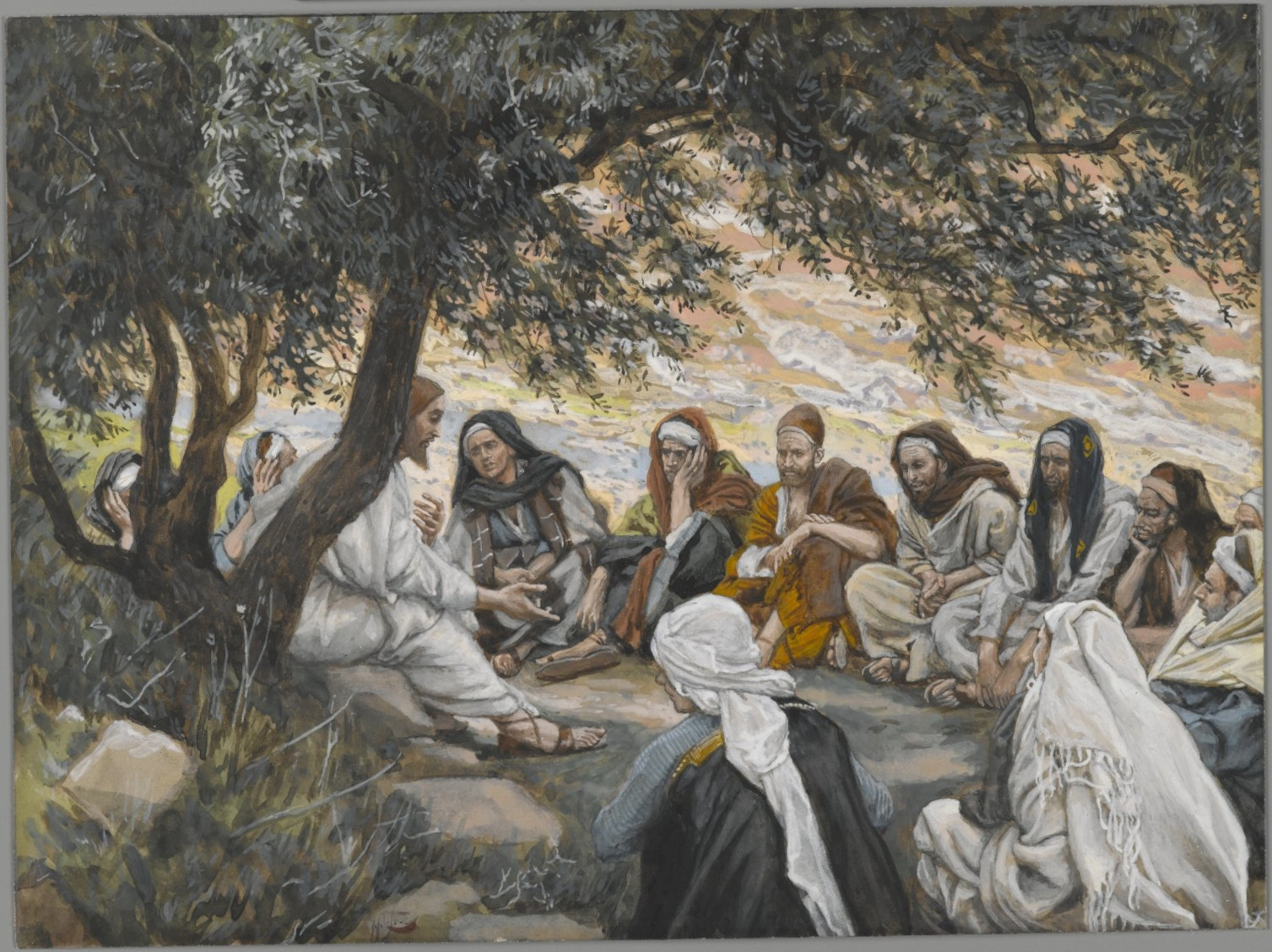
Image One: The Exhortation to the Apostles by James Tissot.  Wikipedia.  Public Domain.
 
Image Two: One of the Throne-Rooms of the Bavarian King by Gryffindor.  Wikipedia.  Public Domain.
 
Image Three: Christ Healing the Blind by El Greco.  Wikipedia.  Public Domain.

Monday, December 31, 2012

Sensitive Issues with Demons - : Matthew 17:14-21

The Scripture Passage
 
14 When they came to the crowd, a man came up to Jesus, falling on his knees before Him and saying,
 
15 "Lord, have mercy on my son, for he is a lunatic and is very ill; for he often falls into the fire and often into the water.
 
16 "I brought him to Your disciples, and they could not cure him."
 
17 And Jesus answered and said, "You unbelieving and perverted generation, how long shall I be with you?  How long shall I put up with you?  Bring him here to Me."
 
18 And Jesus rebuked him, and the demon came out of him, and the boy was cured at once.
 
19 Then the disciples came to Jesus privately and said, "Why could we not drive it out?"
 
20 And He said to them, "Because of the littleness of your faith; for truly I say to you, if you have faith the size of a mustard seed, you will say to this mountain, 'Move from here to there,' and it will move; and nothing will be impossible to you.
 
21 ["But this kind does not go out except by prayer and fasting."]
 
Was He Really Possessed, or Just Crazy?
 
The boy in this story was a "lunatic" - someone completely out of his mind and who was a danger to himself.  Because the Bible identifies the source of his insanity as a demon, some people take one of two extreme views (both of which are Biblically inaccurate) of the situation.
 
First, some claim that New Testament people misunderstood psychological illness as demon possession, that this mistake was further committed by the Gospel writers, and that Jesus either (as a man living at that time) believed the same or just went along with their belief that it was a demon even though he knew it wasn't.  However, there are a couple major problems with this view: (1) One of the central beliefs of genuine Christianity is that the Bible is fully inspired by God and has absolutely no errors (see 2 Timothy 3:16-17).  Therefore, to say that the Gospel writers made a mistake would be to wander into dangerous, cultish territory.  (I won't spend much time on whether or not Jesus, in His human state in which He temporarily gave up His power to know everything, could have made such a mistake because exactly how much Jesus did and did not know while on Earth is an endless debate...I'll just leave it at: I personally do not believe such a mistake would have been possible for Him because, although He gave up His ability to know everything, He maintained deep knowledge of spiritual matters, and this falls into that category.)  (2)  If you read through the accounts of healings and castings-out in the Gospels, some maladies are identified as actual physical problems, in which case Christ healed them, and other maladies are identified as demonic manifestations, in which case Christ cast the demon out.  The distinction is made in Scripture, so clearly, some illnesses (physical or psychological) are truly caused by demonic possessions.
 
The Second dangerous viewpoint is that all psychological problems are caused by demons; in other words, the view is that if you suffer from depression, or obsessive compulsive disorder, or schizophrenia, or epilepsy, or bipolar disorder, or have a clown phobia, or whatever, you are possessed by a demon.  I take extreme issue with this view, as well.  (1) In the Gospels, demons aren't just the cause of psychological maladies, they also cause physical illnesses and handicaps.  So, to say demons cause all psychological problems would require you to say that they cause all physical problems - and that circles back to what we discussed above, how Scripture makes it absolutely clear that some problems are caused by demons, and others are not.  The fact of the matter is, we live in a fallen world where people get diseases and handicaps and disorders because humanity is sinful and fallen, not because of demons.  (2)  Plenty of believers have psychological problems.  As I have mentioned a few times before, there is not a single Scriptural indication I'm aware of that Christians can become possessed, and I think there are even direct hints in Scripture that it cannot happen.  If all psychological problems were the result of demonic possession, no Christian would ever suffer from them.
 
So, to sum up: Some problems really are caused by demons (so don't just write these accounts off as an antiquated, pre-medical way of thinking), but all of them certainly are not (so if someone you know is suffering from a psychological malady, don't think they're possessed).
 
When Should a Christian Cast Out a Demon?
 
The issue of casting out demons itself is another issue of stark polarity, ranging from, "We don't really see a lot of possessions in America...and it scares me, so I just don't want to think about it!" to "Every single problem in every person's life is caused by demons, so I cast 'em out five times a day!"  It's an issue I've mulled over in my mind and searched out in Scripture for about the past four years, and I've finally focused on a couple of indications in Scripture that seem to be really relevant guidelines.
 
First, in every case in the Gospels I can find where Jesus casts out a demon, it is specifically stated that the possessed person's friends or relatives brought that person to Jesus to get the demon cast out.  The only exception to this that I'm aware of is in Mark 5:1-20, in which the possessed man sees Jesus from a distance and runs up to Him specifically to talk to Him.  So, it doesn't seem like every time Jesus saw a possessed person, He cast it out - rather, they or someone they loved seemed to desire for release from the demon, and then He cast it out.  It's kind of like how in Luke 11:24-26 if a person gets a demon cast out of them and there's no change in their life, the demon will just come back.  Think about it - if a demon is cast out of a Satanist, and they keep worshipping Satan, of course it makes sense that they'll just get possessed again.
 
Another telling example is in Acts 16:16-18, in which a demon possessed girl follows Paul for a number of days, shouting as he tries to preach - and he doesn't cast the demon out until he becomes "greatly annoyed" at the end of "many days."  Now, wouldn't you think that if we were supposed to cast out demons whenever we encountered them (instead of when someone specifically asked for the casting-out), Paul would have cast out the demon right away?  But he didn't.  He only did, finally, when it seems the demon possessed person was impeding his ministry.
 
So, the tentative conclusion I've arrived at so far is this: Believers are not intended to cast out any demon they encounter willy-nilly, but rather in cases where the possessed person or their friends/family specifically wants freedom from the demon, or where the demonic possession is interfering with a ministry.
 
Can a Demon Possess a CHILD?
 
In this story, the son's age is not indicated - he could easily be an adult (the same is true in Matthew 15:21-28).  So, with the vagueness in those examples, we have no Biblical indication that children either can or cannot become demon possessed.
 
But here's the thing.  Although different Christian branches and denominations hold to specific "ages of accountability" at which point a child becomes old enough to comprehend issues like sin and salvation, no such age appears anywhere in Scripture.  Now, that doesn't mean that the principle isn't perhaps valid (here is a fascinating discussion of that issue at GotQuestions.org), just that it is absolutely wrong to assign some specific man-determined age.  I personally have seen some children seem to grasp the Gospel as five and others not able to until they were just into their double-digits - it seems to vary from person to person.
 
So, if a child can make a decision to trust Christ as Savior, it follows that they could make the conscious decision to dabble in the demonic realm.  If a kid is playing with a Ouija board or Tarot card deck or "playing pretend" as a wizard or fortune teller, I think it's entirely possible they could become possessed.  We don't know - so let's not risk it.
 
Why Couldn't the Disciples Cast Out the Demon?
 
The problem here is lack of faith.  While there are plenty of Scriptural examples of the person who seeks to be healed needing faith in order for the healing to succeed (for example, Matthew 9:27-29), there are also places where the healer (or demon-caster-outer) must have faith, such as here and in James 5:15.  Although this is tangential to the main point, I find it interesting that heretical televangelists always blame failed miracles on the other person's faith instead of on themselves...
 
Anyway, why did the disciples lack adequate faith in this case?  I mean, they'd cast out demons before (see Matthew 10:1-8, and the parallel passage in Mark 6:7-13 which records their success).  Perhaps they were scared since this seemed to be quite an extreme case of demonic possession (lunacy and trying to kill the man, as opposed to more minor manifestations such as demons causing blindness).  Or, perhaps their lack of faith in God was a result of too much faith in their own abilities - i.e., they had grown arrogant in their power to cast out demons.  This latter case would explain Jesus's harsh reaction, and especially why He told them they had to fast and pray to cast out the demon.  Fasting and praying focuses us back on God's provision, not our own abilities.
 
What About That Verse in Brackets?
 
You may have noticed that verse 21 is in brackets - this is because it appears in some of the original source manuscripts, but not all of them.  Different translations will approach such verses in different ways: Some put them in brackets, or italics, or in the footnotes, and some pick and choose which such verses to include and reject without any indication to the reader that they did so (the NIV does this, which is one of the reasons I'm not a big fan of that translation - but please don't be offended if you prefer the NIV).
 
How do such discrepancies appear in Scripture?  Well, if you think about the process by which the "books" of the New Testament were copied, it was all by hand, a lot by largely uneducated men, and probably quite often in a hurry.  So, even though the original writing was inspired by God, there's no reason to think that every single act of copying it was guided directly by God, as well.  So, that would explain why some verses don't appear in some manuscripts (a person could have mistakenly skipped over it).  In addition, the New Testament books were not all necessarily regarded as Scripture the minute they were written, so a copier who had something they remembered or thought to add would have seen no moral reason not to write that in (which explains why some verses do appear in some manuscripts but not in others.  And, with both of these, one addition or subtraction would be carried on to the copy of that copy, and the copy of the copy of the copy, and on and on exponentially.
 
So how does this mesh with our belief in the inerrancy of Scripture?  Personally, I don't see a conflict.  The fact that we're aware of where the discrepancies are and that none of them have to do with anything important (like being the basis of a doctrine) demonstrates to Me that God protects His Word even amidst human mistakes.  In that light, the discrepancies support the idea that the Bible has remained the same, not the opposite.
 
Now, every Bible teacher you talk to will probably have a different approach to how to handle these "bracketed" verses.  Some reject them all, some accept them all, and some go with a case-by-case approach based on some criteria.
 
I myself fall within the case-by-case category.  My personal method is to check if it's the King James Version Bible.  Even though I am definitely not the type of person who insists that the KJV is the only or even most accurate English translation of Scripture (as evidenced by the fact that I frequently pull from the NASB, ESV, NKJV, and AMP translations), I personally choose to treat it as the authority in the specific issue of "bracketed" verses.  Why?  Let's look at history...
 
The KJV was translated from 1604-1611 using the same Greek source texts as were used for the Latin versions.  The primary Latin version accepted at the time was the "Authorized Latin Version," which was translated by St. Jerome in the 400s.  Before him, Latin versions were translated from the same texts as early as the 100s (about as close to the original time period as you can get).  Therefore, those specific Greek texts were what gave the entire continent of Europe their New Testament for 1500 years.  Personally, I believe that God is powerful enough to not have an incomplete or flawed Word for 1500 years!!!  So, when I encounter a "bracketed" verse, I check to see if it's in the KJV - if so, I treat it as Scripture, if not, I treat it as something that is perhaps true but not Scripture.
 
But, again, that is my personal method.  I'm not saying it's the only way or the best way to approach such verses - it's just my way.
 
An Important Reminder and Questions for You
 
If you want to read through the Bible in 2013, check out the "Weekly Scripture Readings" tab above for a Through the Bible in a Year plan I developed, or check out this past weekend's post referring you to some other plans to best fit your needs.  Make sure you find some way to dive into God's Word every day in 2013!!!
 
What is your approach (or thoughts on an approach) to the "bracketed" verses?
What's your take on the issue of whether or not children can become possessed?
Anything else you'd like to add or ask?


All Images courtesy of Sweet Publishing.  Used by permission.
 

Friday, December 28, 2012

Disecting the Transfiguration: Matthew 17:1-13


The Scripture Passage
 
1 Six days later Jesus took with Him Peter and James and John his brother, and led them up on a high mountain by themselves.
 
2 And He was transfigured before them; and His face shone like the sun, and His garments became white as light.
 
3 And behold, Moses and Elijah appeared to them, talking with Him.
 
4 Peter said to Jesus, "Lord, it is good for us to be here; if You wish, I will make three tabernacles here, one for You, and one for Moses, and one for Elijah."
 
5 While he was still speaking, a bright cloud overshadowed them, and behold, a voice out of the cloud said, "This is My beloved Son, with whom I am well-pleased; listen to Him!"
 
6 When the disciples heard this, they fell face down to the ground and were terrified.
 
7 And Jesus came to them and touched them and said, "Get up, and do not be afraid."
 
8 And lifting up their eyes, they saw no one except Jesus Himself alone.
 
9 As they were coming down from the mountain, Jesus commanded them, saying, "Tell the vision to no one until the Son of Man has risen from the dead."
 
10 And His disciples asked Him, "Why then do the scribes say that Elijah must come first?"
 
11 And He answered and said, "Elijah is coming and will restore all things;
 
12 but I say to you that Elijah already came, and they did not recognize him, but did to him whatever they wished.  So also the Son of Man is going to suffer at their hands."
 
13 Then the disciples understood that He had spoken to them about John the Baptist.
 
Transfigured Glory
 

What does it mean to be transfigured?  Well, if you look in the original Greek, it means...transfigured.  Basically, the only explanation we have is contained in the description that follows the word: a shining face and glowing clothes.  In modern terms, we might think of it as similar to shape-shifting.  Jesus was just miraculously transformed temporarily into something with more glory than a human.  Yet, I don't think this was Jesus being revealed in His full glory to the three disciples.  You see, no man can see God in His glory and live.  While there are exceptions when prophets witnessed God's glory (you'll run into some descriptions in the Old Testament), (1) These were in visions, not a physical, face-to-face state like the disciples saw Jesus in, (2) this description is only a small portion compared to other descriptions of God's glory, and (3) most importantly, reactions to seeing God's glory in visions were quite extreme, certainly not a matter of "Hey, I've got an idea - let's pitch some tents!"  If you're interested in what God's glory looks like, and people's reactions to seeing it, check out Revelation 1:12-17 and Ezekiel 1:26-2:2.  So anyway, I think this was sort of a "partial glory" - the disciples saw a bit of His deity in that incident, but He wasn't revealed to them with the outward appearance of His fully-God side...if so, then it was a perfect picture of Christ being both Man and God.
 
But when the disciples hear the voice of the Father, far less masked than Jesus's glory, their reaction of falling on their faces in terror is the appropriate reaction of human beings before the Almighty revealed in all His perfection - and, I believe, and unavoidable reaction.  We sinful human beings simply cannot handle that much Perfection.  And here's the thing - the Father even kept Himself behind a cloud (like He did for the ancient Israelites) to shield them from His full glory, and they still couldn't help but face-plant!  As C.S. Lewis wrote in Mere Christianity, "God is the only comfort, He is also the supreme terror...Some people talk as if meeting the gaze of absolute goodness would be fun.  They need to think again.  They are only playing with religion."
 
Now, I take the booming voice of God proclaiming, "Listen to Him!!!!" as a firm admonition for thoroughly wrong behavior (as we'll examine in a moment), and the disciples clearly got the message that they messed up - but look what happened next: Jesus immediately offered forgiveness.  The very instant we confess, "God, I screwed up," His arms are open wide to us.
 
Moses and Elijah
 

Why, specifically, were Moses and Elijah present at the transfiguration?  Well, they represented the entirety of the Old Covenant - the Law and the Prophets.  Jesus taught that He was the fulfillment of the Law and the Prophets (in that His death fulfilled the Law's requirements of blood sacrifice for the forgiveness of sin, and that both foretold the coming Messiah), and greater than the old system the Law and Prophets revolved around (in that God is so far beyond human comprehension, we can't even begin to explain Him, even with such an intricate system as the Old Testament Law), and this is where He demonstrated all that.  The transfiguration is how He demonstrated His authority to issue the New Covenant of forgiveness by faith in Christ.
 
This is tangential to the passage, but I find it interesting nonetheless, so I'll share. :-)  It seems God has many plans for Moses and Elijah.  Let's start with their mysterious partings from this Earth.  We know that Elijah did not die, but was rather taken to heaven in a fiery, flying chariot.  Although Moses died, God Himself buried Moses in a secret place, and the angel Michael and Satan apparently fought over the body at one point.  Weird, right?  Well, it's thought that God wanted Moses and Elijah to reappear here at the transfiguration, and perhaps later as the Two Witnesses in Revelation 11:1-14.  A lot of it's speculation, but...the mystery is intriguing.
 
The Disciples' Roles in this Scene
 

Peter, James, and John were sort of Jesus's closest three disciples (He had the 3, the 12, the 70, and then all His followers).  And even the best three screwed up colossally (here, and elsewhere) - which is very encouraging for us in that it demonstrates that God loves us, too, no matter how much or how often we fail Him.  So what exactly did they do wrong here?
Well, a tabernacle wasn't just a tent - in the Judaic context, it was a holy tent.  Jews lived in them during the "Feast of Tabernacles (or Booths)," but most importantly, before the Temple was built, God met with His people in a sacred Tabernacle.  So, by offering to build a tabernacle for each of them, the disciples demonstrated that they though Moses and Elijah were on an equal plain with the Messiah!  In other words, they completely missed the entire point of the experience: that Jesus is greater than the Law and Prophets, that Jesus, as God, is far greater than the heroes of the faith.  Jesus was not just some prophet or teacher; He is God Himself.
 
But we shouldn't ignore the fact that after the reprimand, the disciples did something very admirable: They paid attention to what had happened, connected that event to what they had already learned, and asked a question about it...
 
Elijah Here, Elijah There, Elijah Everywhere!


Was John the Baptist literally Elijah, back on Earth?  Yes and no.  Just as Elisha asked for a double portion of Elijah's spirit, John the Baptist came "in the spirit and power of Elijah."  Elsewhere, Jesus says, "If you are willing to accept it, John himself is Elijah who was to come."  The "if you are willing to accept it" basically means...yes and no. :-)  In John 1:21, John explicitly stated that he was not actually Elijah...but sometimes Jesus says he kind of was...  Just as, when we do something in Jesus's name, we are doing it in the capacity of Jesus or as Jesus would do it, coming in the spirit of Elijah doesn't mean actually having Elijah's soul in you, but rather, acting in the same manner as Elijah did and in a way that harkens back to Elijah...but with special involvement by the spiritual realm.  The specifics of this are quite hazy, but basically, this is what we know: The Messianic prophecy in Malachi 4:5-6 states that Elijah will return before the Day of the Lord (in the End Times) to turn people's hearts back to God.  John the Baptist was a partial fulfillment to this - he was a precursor, a pseudo-Elijah present at Christ's first coming, while the literal Elijah will be sent to Earth again to herald Christ's second coming.  They both serve the same purpose: To proclaim Christ, and bring people to repentance and faith in God.
 
Anything you'd like to add to the discussion or ask?  Comment below. :-)
 
Image Number One: The Transfiguration, by Lodovico Carracci.  Wikipedia. Public domain in the United States.
Image Number Two: Torah and Jad.  Wikipedia. Used by permission.
Image Number Three: St. Paul Writing His Epistles, by Valentin de Boulogne.  Wikipedia.  {{PD-1923}} Public domain in the United States.
Image Number Four: Greek icon of Elias (Elijah).  Wikipedia.  {{PD-1923}} Public domain in the United States.  {{PD-old-70}} Public domain in the Europen Union, including Greece, the source country.


Saturday, December 15, 2012

Distraction and Precision - Matthew 16:1-19

Quest for Signs
 
1 The Pharisees and Sadducees came up, and testing Jesus, they asked Him to show them a sign from heaven.
 
2 But He replied to them, "When it is evening, you say, 'It will be fair weather, for the sky is red.'
 
3 "And in the morning, 'There will be a storm today, for the sky is red and threatening.'  Do you know how to discern the appearance of the sky, but cannot discern the signs of the times?
 
4 "An evil and adulterous generation seeks after a sign; and a sign will not be given it, except the sign of Jonah."
 
The absurdity of the Pharisees and Sadducees asking for a sign is apparent when we consider all that Jesus had done - healing tons of people from all sorts of serious ailments, casting out demons, then miraculously feeding somewhere around 10,000-20,000 people (once you count in women and children).  These stories were obviously circulating throghout Israel (given the large crowds that sought out Jesus), so the Pharisees and Sadducees had surely heard of them - and some of them had certainly witnessed these miracles themselves!  But the fact of the matter is, they were ignoring the proof right before our eyes.  If we refuse to believe something, we can trick ourselves into thinking the most convincing of evidence doesn't exist.
 
Jesus's example of how they're blatantly ignoring what's right before their eyes is an old nautical trick you might have heard of before - "Red sky at night, sailor's delight; red sky at morning, sailor's warning."  These Pharisees and Sadducees not had heard testimonies of (and likely witnessed themselves) Jesus's miracles, but they were the Scripture scholars of their day - of all people in Israel, they were the experts on God's Law, which meant they were familiar with all of the Messianic prophecies.  They should have been able to immediately recognize the Messiah, yet they refused to, essentially blinding their own eyes.
 
The problem wasn't that they wanted a sign; it's that they ignored all the obvious signs they'd already seen, always asking for one more, one more, one more.  Even though it had already been proven, they wanted more proof.  They had absolutely no faith!  1 Corinthians 14:22 states that some types of signs (tongues, in that verse) are to open unbelievers' eyes, but others types of signs (prophecy, in that verse) are for believers - basically a reward for the faith of those who already believe.  God's not out to convince us of anything - He will persuade, but we have to have faith and believe.
 
Let us ask ourselves:  What is God trying to tell me right now that I'm ignoring?  And what amazing revelations or experiences am I missing out on because I refuse to "step out" in faith?
 
Okay, so what's with the sign of Jonah?  Well, Jonah was an Old Testament prophet who, while running from God's plan for him, was swallowed by a large fish and stayed in its belly for three days.  Just the same, when Jesus was killed, He stayed in the tomb for three days before rising from the dead.  His resurrection was His ultimate sign to unbelievers - something so huge, it's nearly impossible to turn a blind eye to it...but it's up to each individual to decide whether to believe it or not.
 
A Dozen Distracted Disciples
 
5 And the disciples came to the other side of the sea, but they had forgotten to bring any bread.
 
6 And Jesus said to them, "Watch out and beware of the leaven of the Pharisees and Sadducees."
 
7 They began to discuss this among themselves, saying, "He said that because we did not bring any bread."
 
8 But Jesus, aware of this, said, "You men of little faith, why do you discuss among yourselves that you have no bread?
 
9 "Do you not yet understand or remember the five loaves of the five thousand, and how many baskets full you picked up?
 
10 "Or the seven loaves of the four thousand, and how many large baskets full you picked up?
 
11 "How is it that you do not understand that I did not speak to you concerning bread?  But beware of the leaven of the Pharisees and Sadducees."
 
12 Then they understood that He did not say to beware of the leaven of bread, but of the teaching of the Pharisees and Sadducees.
 
Here, we find the disciples quite distracted by their hunger, causing them to completely misunderstand what Jesus is trying to tell them.  When we get focused in on and obsessed with this world, whether that be genuine needs or worldy pleasures, we can become oblivious to the eternal truths God is communicating - we can even twist what He says!
 
I think Jesus was quite angry at the disciples in this passage, and (obviously) rightfully so.  They had so little faith - they become obsessed with the very thing He had told them and shown them they didn't need to waste time worrying about.  It was essentially a god to them - because I hold that any obsession or addiction is an idol.  They had allowed their hearts to ignore and "forget" all that Jesus had taught and demonstratred to them - in this, they were doing exactly what the Pharisees were doing.
 
Their "Ah-ha!" or "Ohhhhh" moment is when they realized He was warning them against the religious leaders' false teaching (because, remember - it's possible they still saw them as genuine leaders appointed by God), but it's possible that what He demonstrated to them by their own response (what we just saw above) was another, potentially greater lesson.
 
Peter Totally Redeems Himself
 
13 Now when Jesus came into the district of Caesarea Philippi, He was asking His disciples, "Who do people say that the Son of Man is?"
 
14 And they said, "Some say John the Baptist; and others, Elijah; but still others, Jeremiah, or one of the prophets."
 
15 He said to them, "But who do you say that I am?"
 
16 Simon Peter answered, "You are the Christ, the Son of the living God."
 
17 And Jesus said to him, "Blessed are you, Simon Barjona, because flesh and blood did not reveal this to you, but My Father who is in heaven.
 
18 "I also say to you that you are Peter, and upon this rock I will build My church; and the gates of Hades will not overpower it.
 
 
When Jesus asks the disciples to list off different peoples' views as to His identity, it becomes clear to us that many Jews of that day thought He was a prophet back from the dead (or back from the non-dead, in Elijah's case) - that would certainly explain His miraculous powers.  But while they're all quite responsive to His first question, only one man is bold enough to say who he thinks Jesus is, the Messiah.  And he says it bluntly and unabashedly - he doesn't qualify it with "maybe" or "perhaps," he confesses it out of faith.
 
The Gospels' recordings of Jesus's interaction with His disciples are so comforting for us, because they demonstrate how, no matter how rocky our own walks with Christ our, He still loves us.  In our last record, Simon Peter was among those scolded for being so obsessed with getting supper he wasn't even listening to Jesus speak, and as we read through the Gospels, we see that Simon Peter messes up prettymuch the most of any disciple.  And yet, despite his many failings, he also has many successes - just because he's trying to follow Jesus.  One such example when he is honored is here in this passage.  Even when we fall into sin or fall away from the faith for a time, God still loves us and is willing to use us for great things the moment we return to Him.  The fact that his willingness and faith were rewarded with God revealing Jesus's identity to him and using him in such great ways harkens back to what we discussed above.
 
Let's talk about names really quickly.  Jesus calls him "Simon Barjona" - Simon was the name his parents gave him, and Barjona just means "son of Jonah" (one way the Jews referred to each other).  But Jesus renames him Peter, which is a name meaning "rock."  It's sturdy, stable, a foundation - as in, something you could build on.  The point is that Peter represented genuine faith, even though he was in the minority - one of the basics of Christianity, as Matthew 7:13-14 tells us.  So, it's not exactly that Jesus is building His Church on Peter himself (although Peter on of the very top church leaders after the resurrection), it's that He's building the Church on the principle that Peter had just expressed in that moment.
 
Wondering about the Gates of Hades thing?  We'll get to that in our next study post, when we address the convoluted of Binding and Loosing. :-)
 
Questions for You
 
Has there been a time when you've blinded yourself to a truth God was trying to teach you?
 
Has there been a time when you've been the only one in a crowd to unabashedly proclaim God's truth?
 
Any other insights to this passage you'd like to share, or questions you'd like to ask?
 
Giving Credit Where It's Due
 
Image Number One: Sunrise on Sea, by Stig Nygaard.  Wikipedia. Used by permission.
 
Image Number Two: Brot und Backwaren, by Klaus Hopfner.  Wikipedia. Used by permission.
 
Image Number Three courtesy of Sweet Publishing.

Monday, December 10, 2012

Racism and Deja Vu? - Matthew 15:21-39

The Syrophonecian Woman
 
21 Jesus went away from there, and withdrew into the district of Tyre and Sidon.
 
22 And a Canaanite woman from that region came out and began to cry out, saying, "Have mercy on me, Lord, Son of David; my daughter is cruelly demon-possessed."
 
23 But He did not answer her a waord.  And His disciples came and implored Him, saying, "Send her away, because she keeps shouting at us."
 
24 But He answered and said, "I was sent only to the lost sheep of the house of Israel."
 
25 But she came and began to bow down before Him, saying, "Lord, help me!"
 
26 And He answered and said, "It is not good to take the children's bread and throw it to the dogs."
 
27 But she said, "Yes, Lord; but even the dogs feed on the crumbs which fall from their masters' table."
 
28 The Jesus said to her, "O woman, your faith is great; it shall be done for you as you wish."  And her daughter was healed at once."
 
I don't usually spend time on the locations these events occurred in, but I think this story is a useful opportunity to discuss it a bit.  Jesus was in Gennesaret before, which was a town next to Capernaum on the coast of the sea of Galilee (an inland sea).  In this story, he travels to the region of Tyre and Sidon (two "heathen" cities famous in the Old Testament), which are about 40 miles to the North-West of Gennesaret, and are coastal cities on the Mediterranian Sea.  They were in non-Jewish territory, and were even outside Herod's jurisdiction.  Which brings us to the important question here: Why on earth would Jesus travel there? 
 
One possibility is that the Pharisees started plotting to kill Him after their encounter with Him that occurred immediatly before these verses (although that is not mentioned in this passage, as it is elsewhere), and He departed to elude their grasp.  Another possibility is hinted at at the parallel verse in Mark 7:24 - that He needed a break from the crowds, so He went far away into non-Jewish territory where perhaps He would not be recognized.  If this is the case, perhaps He did so in order that He could focus on teaching His disciples (which is more important, from an eternal perspective) instead of all his time being consumed with physical healings.  But, in the end, we don't know for sure why He ever travelled where He did.  Indeed, there are numerous instances in the Gospels where locations are mentioned for no apparent reason.  Perahps the authors of the Gospels mentioned the locations to add validity to their accounts of Jesus's life.
 
We get to witness here another case of the disciples not exactly being at their best.  Before judging them too harshly, we should remember that in thier culture, women were of extremely low caste, and Gentiles were looked on with derision, so the disciples' reaction to this Gentile woman "pestering" them and their Teacher was normal for their culture.  But, normal does not mean right.  Just because something is accepted in our culture does not mean it meets God's standards of correct behavior (in this case, love).
 
But then, what are we to make of Jesus's response?  Did he really coldly call her a dog?  Not at all!  You see, in His day, "dog" was a common slur that Jews used to refer to Gentiles.  But the word that Jesus used meant "puppy."  He made sure that the true, loving intent of His analogy was not misunderstood by doing a play on the word "dog" that actually made it...nice - a compliment of sorts.  From the context, it seems that this entire conversation is His usual playful way of engaging someone as a test of their faith.
 
It is also important to understand that when Jesus was on Earth, His intended ministry really was to reach out first to Israel.  After all, the Messiah was the promised one to Israel.  After His resurrection was when the faith was going to expand among the Gentiles.  The reason for this is that, in the interest of fairness, God gave Israel a "fair shake" at accepting the Messiah first - so that when they rejected Him, it was completely on their heads, because they had every chance to accept Him.  And remember, God still had a covenant to fulfill with the Jews when He sent the Messiah.  If you take a look at Romans 2:9-11, you'll find that God acting chronologically (Jews, then Gentiles) does not indicate any inequality between Jews and Gentiles (see Galatians 3:28).  Romans 11 discusses this issue a bit more.  But the point I'm trying to get to is this: Even though Jesus had a specific purpose in focusing His ministry on Israel for a few years (2-3) before His Church expanded to actively reach out to the Gentiles, He didn't let that stop Him from having compassion on this Gentile woman and helping her.
 
Let's briefly look at the woman's faith, too.  (1) She recognized Him as the true God, even though her pagan culture surely lauded other (false) gods.  That means she was so sure in her belief that she was willing to risk that.  (2) She was willing to endure the disciples' ridicule and scorn (which she probably expected before she even came to them) to get to Jesus.  (3) She surely would have believed that, based on other world religions at the time, the Jewish God was not obligated to help someone not of those people - yet she trusted in His love enough that she came to Him and pressed Him.  Her faith was great, indeed.
 
Healing the Multitudes
 
29 Departing from there, Jesus went along by the Sea of Galilee, and having gone up on the mountain, He was sitting there.
 
30 And large crowds came to Him, bringing with them those who were lame, crippled, blind, mute, and many others, and they laid them down at His feet; and He healed them.
 
31 So the crowd marveled as they saw the mute speaking, the crippled restored, and the lame walking, and the blind seeing; and they glorified the God of Israel.
 
It's easy to lose sight of how amazing these mass healings really are after we've heard the stories a number of times.  So, it's a good idea to take some time to meditate on what it would have been like to actually experience this.
 
This account reminds me of a few lyrics I love from the song "Mary, Did You Know?"  They say, "The blind will see, the deaf will hear, the dead will live again!  The lame will leap, the dumb with speak - the praises of the Lamb!"
 
Consider for a moment that, before John the Baptist, the Jews had not had a Prophet of Old in centuries, and were under foreign captivity - they felt as if God had completely rejected them.  So, the presence of a Prophet at all - and the ultimate Prophet, Jesus, who was performing so many miracles for them - was a shocking testament of God's love for them.  The fact that they had gone three full days without eating just to remain with Him (as we'll see in a moment) is proof of how deeply this affected them.
 
Four Thousand Fed
 
32 And Jesus called His disciples to Him, and said, "I feel compassion for the people, because they have remained with Me now three days and have nothing to eat; and I do not want to send them away hungry, for they might faint on the way."
 
33 The disciples said to Him, "Where would we get so many loaves in this desolate place to satisfy such a large crowd?"
 
34 And Jesus said to them, "How many loaves do you have?"  And they said, "Seven, and a few small fish."
 
35 And He directed the people to sit down on the ground;
 
36 and He took the seven loaves and the fish; and giving thanks, He broke them and started giving them to the disciples, and the disciples gave them to the people.
 
37 And they all ate and were satisfied, and they picked up what was left over of the broken pieces, seven large baskets full.
 
38 And those who ate were four thousand men, besides women and children.
 
39 And sending away the crowds, Jesus got into the boat and came to the region of Magadan.
 
If this story sounds extremely familiar, it's because we very recently covered the feeding of the five thousand (you can read that post here).  Why would Matthew write such similar accounts almost back-to-back?  I have a couple of theories... :-)  Even though it's the exact same scenario, there are some new lessons here that we shouldn't overlook.
 
First off, this is perhaps the most shocking picture in all of the Gospels of how Jesus's disciples simply did not learn and lacked faith to an astounding degree.  But, how often are we just like them?  It seems like God has to teach us the same lessons over and over - that's no different, no less terrible, than what's going on in this passage.
 
Second, the fact that Jesus fed 5,000+ the first time, and 4,000+ the second time demonstrates that He's not interested in one-upping Himself.  God provides in whatever way He thinks is appropriate for the situation - so we shouldn't be disappointed if God seems to do "less" for us than He does for someone else.
 
Third, the number of baskets left over before (12) was symbolic, and it is here, as well.  Seven is the number of completion or perfection.  This backs up the above point that God's will is to do whatever is perfect for that situation.  It also demonstrates that God will take care of us completely.
 
Questions for You
 
When have you been treated poorly by people who claimed to represent God (like happened to the Syrophonecian woman)?
 
Have you ever had an experience where God did less than you expected, but it still was enough provision?
 
Anything else you'd like to comment on - or add to the discussion?
 
Any questions?
 
Giving Credit Where It's Due
 
All images courtesy of Sweet Publishing.  Used by permission.