Showing posts with label Pride. Show all posts

Saturday, September 21, 2013

A Passage People Rush Through - Matthew 23:1-12

Today's passage isn't really considered deep from a study perspective - there are minimal analogies and Biblical history involved, nothing that demands digging into original languages, and no prophetic elements.  However, from the viewpoint of personal application, there is an abundance of critical information here.  I mean, think about it - if the God of the universe says something is important enough to go in His Book, we should pay attention, right? ;-)  Anyway, because of the nature of this passage, I recommend that you read this post at a time when you're not rushed so that you can reflect on your own heart along the way.  I prompt these private reflections in green lettering.

Let's dive in! :-)
 
 
1 Then Jesus spoke to the crowds and to His disciples,
 
2 saying: "The scribes and the Pharisees have seated themselves in the chair of Moses;
 
3 therefore all that they tell you, do and observe, but do not do according to their deeds; for they say things and do not do them.
 
"Seating themselves in the chair of Moses" is a way of saying that these religious leaders were trying to get others to recognize them with the ultimate status, prestige, and authority.  To put this in modern terms, it's someone putting himself in the chair of the Pope or Billy Graham.
 
In what ways do you seek to be above any others, whether that be in status/prestige or in authority over them?
 
These religious leaders were also hypocrites, demanding that others obey enormous sets of rules that they themselves couldn't even follow.
 
Are there things you judge other people for doing, yet also struggle with yourself?  Or, is your issue comparing sins - thinking that what you do wrong is "less bad" than what others do?
 
In this case, Jesus told the listeners to follow the teachings of the religious leaders, I think likely because of the reasons Paul referenced in 1 Corinthians 8, limiting the freedom in Christ you know you are entitled to so you don't offend others.  (There may be other reasons in this specific case, as well.)  But motivation is key here - we don't want to become just like the Pharisees in the process!  So, we should constantly keep humility at the forefront of our minds.
 
Are there situations where you've gone along with something you considered legalistic or unnecessarily restrictive to avoid offending people, then began to get comfortable with it and expect others to live the same way?  (I'm not talking about things that really were wrong to begin with and you came to learn that.)
 
4 "They tie up heavy burdens and lay them on men's shoulders, but they themselves are unwilling to move them with so much as a finger.
 
We've already talked about the hypocritical legalism aspect of this, but another application to modern life I've seen has to do with effort.  I've seen situations where some people look like they're really involved in a ministry or project, but really just be organizing and delegating.  Now, sometimes, this can be a genuine manifestation of the gift of administration, but other times, it can be a very, very bad thing where someone wants all the credit for doing little of the work.
 
Does what I've said above strike a chord with any aspect of your life?
 
5 "But they do all their deeds to be noticed by men; for they broaden their phylacteries and lengthen the tassels of their garments.
 
Phylacteries and tassels were both accessories to religious garb in Ancient Israel (they're still used by some Jewish sects).  So, big phylacteries and long tassels both said "Look how religious I am!" in two ways: They were more cumbersome, making the wearer look more sacrificial, and their size simply drew the eye.
 
Although the specifics have changed, this problem still runs rampant in the Church today.  Sometimes a person who doesn't normally wear a cross necklace for themselves will suddenly wear one just to look extra religious for others.  Or someone who rarely prays to God on their own will be asked to pray over a meal on a religious holiday and go over-the-top with something more like a KJV-stylized speech than a conversation with God.  Of course, there are many, many more manifestations of this.
 
Matthew 6:1-6 has much to say about this topic, as well.
 
What aspects that you associate with your faith would you not do if no one else was around and it was just you and God?
 
6 "They love the place of honor at banquets and the chief seats in the synagogues,
 
7 and respectful greetings in the market places, and being called Rabbi by men.
 
8 "But do not be called Rabbi; for One is your Teacher, and you are all brothers.
 
9 "Do not call anyone on earth your father; for One is your Father, He who is in heaven."
 
Once again, this is far too applicable to the modern Church!  I cringe when I hear a religious leader insist on being called "Reverend so-and-so" or "Pastor so-and-so" or "Dr. so-and-so."  Someone in this person's congregation choosing to call them "Pastor so-and-so" doesn't  normally strike me as an issue, since it's naming their spiritual gift and the leader himself did not request to be called that - but in virtually any other situation, I see it as flying in the face of these verses.
 
Even calling a pastor "Pastor so-and-so" doesn't sit totally okay with me if it's prevalent in a congregation, but for another reason: the clergy-laity divide.  Basically, I don't like anything that separates the "official" clergy/ministry team/whatever you want to call it from what is considered the congregation.  We all have spiritual gifts, and are all intended to use them at church gatherings, so the concept of official clergy is highly unbiblical (see my extensive exploration of spiritual gifts here) (verses 8-9 get at the fact that all believers are equal, as well).  So, if we call someone with the gift of pastoring "Pastor so-and-so," should we call someone with the gift of celibacy "Celibate so-and-so" or the gift of poverty "Willingly-Poor so-and-so" or the gift of tongues "Tongues-er so-and-so"???  But anyway... :-)  This paragraph is more my views that I base on the Bible, and is not something I'm claiming to be taught directly in Scripture.
 
If you're involved in some sort of ministry, do you make a point to mention that as part of your identity when meeting people, or love it when other people bring that up?
 
(One little side-note about verse 9: That's not saying you can't call your dad "Dad," or even that you can't consider the person you brought you to Christ your "father/mother in the faith" - Paul calls Timothy his son, for example.  But what this is getting at is elevating some religious leader to an overly high status, so that it becomes a form of idolatry.)
 
11 "But the greatest among you shall be your servant.
 
12 "Whoever exalts himself shall be humbled; and whoever humbles himself shall be exalted.
 
These final verses are a message we have heard over and over and over and over in Matthew.  That repetition reveals that it's a major issue!  And the many times we've encountered it through Matthew in multiple different contexts, and have seen multiple modern parallels to those contexts, further demonstrates how critical it is to constantly keep this in mind.
 
 
Image credit: "The Synagogue in Florence, Italy" by Toksave.  Wikipedia.  Used by permission.

Tuesday, September 10, 2013

Silencing the Critics - Matthew 22:41-46

Matthew 22:41-46
 
41 Now while the Pharisees were gathered together, Jesus asked them a question:
 
42 "What do you think about the Christ, whose son is He?"  They said to Him, "The son of David."
 
43 He said to them, "Then how does David in the Spirit call Him 'Lord,' saying,
 
44 'THE LORD SAID TO MY LORD, "SIT AT MY RIGHT HAND, UNTIL I PUT YOUR ENEMIES BENEATH YOUR FEET"'?
 
45 "If David then calls Him 'Lord,' how is He his son?"
 
46 No one was able to answer Him a word, nor did anyone dare from that day on to ask Him another question.
 
God of Power
 
We've heard the Pharisees test Jesus time and time again - and every time, He has completely baffled them with His incredible wisdom.  But now, He puts a stop to their arrogant questions, posing a riddle of His own to befuddle them and then proceeding with a long list of accusations and curses against them.  I adore this display of our God's incredible power!  With one simple question, he astounds the listeners so much that "nor did anyone dare from that day on to ask Him another question"!  Studying through Matthew, we have seen so much of Jesus's "Suffering Servant" side, that the few pre-End Times glimpses we get of Him as the Mighty Conqueror are a wonderful variation. :-)
 
So what was Christ's objective with this question?  Well, shutting the Pharisees up, obviously, but specifically: To turn their own tactic against them by demonstrating that they were the ones who didn't understand the Law - they couldn't even explain a simple seeming-contradiction!
 
Whoever exalts himself will be humbled...
- Matthew 23:12a
 
The proud look of man will be abased And the loftiness of man will be humbled, And the Lord alone will be exalted in that day.
- Isaiah 2:11
 
Pour out the overflowings of your anger, And look on everyone who is proud, and make him low.  Look on everyone who is proud, and humble him, And tread down the wicked where they stand.
- Job 40:11-12
 
So let's look at the Old Testament passages that Jesus and the Pharisees are discussing:
  • The Christ's (aka Messiah's) status as a son of David is written all over the Old Testament.  For example, Jeremiah 23:5-6 reads, "Behold, the days are coming," declares the Lord, "When I will raise up for David a righteous Branch; And He will reign as king and act wisely And do justice and righteousness in the land.  In His days Judah will be saved, And Israel will dwell securely; And this is His name by which He will be called, 'The Lord our righteousness.'"  Other good examples you might want to check out are Isaiah 11, Isaiah 9:6-7, and Ezekiel 34:23-24.
  • The verse Jesus references in verse 44 of today's passage is Psalm 110:1, and if you read that entire Psalm (only 7 verses - read it!), you'll see how undeniably Messianic it is.
The quandary facing the Pharisees, then, is how the same "person" could be both David's son and his Lord.  Because of the many revelations Jesus has given to Christians, we know that:
Learn how to accept Jesus as your Lord here in English or here in your own language.

Any questions or comments? :-)

Image credit: "Davide e Golia" by Tanzio da Varallo.  Wikipedia.  Public Domain in the U.S.

Saturday, June 29, 2013

Jesus's Parables Against the Pharisees - Matthew 21:33-46

Very Brief Recap
 
Remember, we're going through the part of Matthew's Gospel where Jesus spends a long time confronting the hypocrisy of the Pharisees and other religious elite.
 
Missed our previous posts on this war of words?  Here are Part 1 and Part 2.
 
Today, we'll look at Jesus's 2nd parable against the religious elite, both dissecting its meaning and looking for how to apply it to our own lives instead of just storing up head knowledge. :-)

This is a very link-happy post where I direct you to Scripture verses and passages, so if you're new around here, links appear hot pink if you're reading on the blog itself and blue if you're reading via e-mail subscription.  Be sure to check them out. :-)
 
The Scripture
 
33 "Listen to another parable.  There was a landowner who PLANTED A VINEYARD AND PUT A WALL AROUND IT AND DUG A WINE PRESS IN IT, AND BUILT A TOWER, and rented it out to vine-growers and went on a journey.
 
34 "When the harvest time approached, he sent his slaves to the vine-growers to receive his produce.
 
35 "The vine-growers took his slaves and beat one, and killed another, and stoned a third.
 
36 "Again he sent another group of slaves larger than the first; and they did the same thing to them.
 
37 "But afterward he sent his son to them, saying, 'They will respect my son.'
 
38 "But when the vine-growers saw the son, they said among themselves, 'This is the heir; come, let us kill him and seize his inheritance.'
 
40 "Therefore when the owner of the vineyard comes, what will he do to those vine-growers?"
 
41 They said to Him, "He will bring those wretches to a wretched end, and will rent out the vineyard to other vine-growers who will pay him the proceeds at the proper seasons."
 
42 Jesus said to them, "Did you never read in the Scriptures, 'THE STONE WHICH THE BUILDERS REJECTED, THIS BECAME THE CHEIF CORNER STONE; THIS CAME ABOUT FROM THE LORD, AND IT IS MARVELOUS IN OUR EYES'?
 
43 "Therefore I say to you, the kingdom of God will be taken away from you and given to a people, producing the fruit of it.
 
44 "And he who falls on this stone will be broken to pieces; but on whomever it falls, it will scatter him like dust."
 
45 When the chief priests and the Pharisees heard His parables, they understood that He was speaking about them.
 
46 When they sought to seize Him, they feared the people, because the considered Him to be a prophet.
 
The Symbols
 

Here's my take on them, anyway... :-)
 
The landowner is God.  God's always the easy one to figure out in parables like this - He's the guy in charge. :-)
 
The vine-growers are, in this case, both all of God's people, and specifically the religious leaders - the people who were given the commission to help God's people grow, but weren't doing their job.  In Matthew 15:14, Jesus called them "blind guides," and in Matthew 23:4, He says that they "tie up heavy burdens and lay them on men's shoulders."  However, for applying this today (and looking in Isaiah 5, the origin of this parable), we should keep in mind that we all have a commission as "God's farmers," that is, to share His Gospel with the world, so we should view this in that light.  We all must produce fruit, we all have a responsibility.
 
The slaves here are the prophets (all the Old Testament ones, plus John the Baptist).  In our culture, the word "slave" is a very negative thing (as it should be), but in the Bible, it doesn't mean the same thing.  In the New Testament, we are referred to as bond-servants 24 times (a bond-servant was a voluntary slave who chose to serve a master they loved), and by my count, only as slaves 5 times (excepting the parables, which are symbolic so they don't count) - three times in Romans 6:16-19, and once each in 1 Corinthians 9:19 and Ephesians 6:6 ... and in all these cases, it is still presented as a matter of voluntary choice.  What's more, Galatians 4:7 is one of multiple verses that explicitly state that God views us as sons and daughters, not slaves.  So, then, being a "slave" is from our perspective - our willing choice to obey God, no matter what.  In the prophets' specific case, they were willing to say "yes" to God even to the point of dying brutal deaths.
 
The vineyard is a bit trickier to pin down.  It could be seen as the world (what we would call the missions field), or as God's people (for us, the Church).  For the Pharisees against whom this was spoken, their primary responsibility was to God's people (again, that's what is portrayed in Isaiah 5), but in modern times, God's followers' "vineyard" is both the Church and the world.  The landowner gave the vine-growers everything they needed to produce fruit in this vineyard (see verse 34), then went on a journey and left it in their hands - just like God gives us every possible way to come to Him, grow in Him, and follow His calling for our lives, but He ultimately leaves the choice of what to do with those gifts up to us.
 
What is this harvest time?  Elsewhere in the New Testament, it can refer to a final judgment scenario or bringing lost souls to Christ.  I don't think it's either of those here, but definitely related.  It seems to me that this is God calling His people to step out in faith in something, perform a good work He has planned for them, come back to Him after a time of rebellion - any of that.  Simply, God expecting fruit.  It makes sense, then, that the prophets would come to "demand" this when spiritual fruit wasn't being given to God.  Good motivation for us - let's serve God all the time so He doesn't have to send another of His followers to point out to us that we're not serving Him! ;-)
 
And finally, the last symbol is the landowner's son - Jesus.  That one's pretty obvious, but what I find interesting is the vine-growers' motivation: They wanted power they knew they weren't entitled to have.  The religious leaders could have seen that Jesus was Messiah far easier than anyone else since they were so familiar with the Scriptures, but I believe they refused to see that for this very reason - because the Messiah wanted to strip them of their wrongful power.
 
The Response
 
The response of the religious elite is disturbing.  They would have been familiar highly familiar with Isaiah 5, which Jesus was boldly alluding to and even directly quoting, and they knew in their hearts what justice would be for the vine-growers (see verse 41).
 
And yet, they were so blinded to their own wickedness that they couldn't see how it applied to them, so they proclaimed the judgment on themselves!
 
We need to constantly be aware of what's going on in our hearts, and ask God to reveal our sin to us, so we are not likewise this blind.
 
Corner Stone
 
For ancient buildings with stone foundations, the corner stone was the first stone laid in the ground, on which the entire house's measurements and alignments would depend - so it had to be flawless.  Jesus is here Himself the cornerstone (see Acts 4:10-12), but in this case, it also applies to the point He's been hammering into their heads and will continue to hammer: that the religious fakers who weren't really serving God did not truly possess the kingdom of God, because it belongs to we wretched sinners who repent and serve the Lord.  In God's eyes, it doesn't matter how badly we've screwed up, or what horrible people the world thinks we are because of those mistakes - when we ask His forgiveness and make Him our Lord, we become perfect stones in His sight, far more righteous than the religious elite who fast and maintain legalism - all because of Christ.
 
Let's look at verse 44 again:
 
And he who falls on this stone will be broken to pieces; but on whomever it falls, it will scatter him like dust.
 
Not as cryptic as it seems. :-)  Let's break it down very simply:
  • Everyone will come into contact with the stone (that is, Christ) - but not in the same way.  Some (the saved) will choose to make their contact with Him here on Earth, but others (the unsaved) will refuse a relationship with Him, only to meet Him at the final judgment.
  • The people the stone falls on are the unsaved (and in this specific case, the unsaved religious elite).  Christ will crush them in final judgment.
  • We who fall on the stone are the ones who choose to bow to the True God.  We will be broken, too, not in judgment, but (1) as we willingly allow God to work in our hearts, removing our sin as we offer Him our "broken spirit" [see Psalm 66:10, Isaiah 48:10, Daniel 12:10, Zechariah 13:9, and Malachi 3:3]; and (2) as we suffer for our God at the hands of unsaved persecutors.
This is a tangent, but relevant:
 
If the devil were wise enough and would stand by in silence and let the gospel be preached, he would suffer less harm.  For when there is no battle for the gospel it rusts and it finds no cause and no occasion to show its vigor and power.  Therefore, nothing better can befall the gospel than that the world should fight it with force and cunning.
- Martin Luther
 
Powerless
 
Finally, at the very end of the chapter, the religious elite realized that they had been duped into condemning themselves, and have been publically ridiculed and denounced.  But Jesus was not done with them yet, and it was not quite the time when He chose to give His life - so we'll go further into this subject next study, as we start Matthew 22.  See you then. :-)
 
Questions for You
 
Is there anything you'd like to add to our discussion?  Maybe you saw something in the parable that I missed, or something really spoke to you that you'd like to expand on.  Or maybe you have a question.  Leave a comment to share. :-)
 
Image Credit
 
Image 1: "A Vineyard" photo taken by Sergei Mikhailovich Prokudin-Gorskii.  Wikipedia.  Public domain in the United States.

Wednesday, June 26, 2013

Jesus Versus the Religious Elite - Matthew 21: 23-32

What's Going on, Again?

Let's review the context of where we are in Matthew.  In our last study, we saw Jesus enter Jerusalem in a spectacle demonstration of His identity as Messiah, literally chase the hypocritical religious establishment out of the Temple, and use a fig tree as a way to teach His followers that the religious elite weren't truly in God's favor.  Obviously, all this behavior really angered the Jewish religious leaders, which ultimately led to their decision to murder Him.  Today, we see the confrontation continue...

You see, as we progress to this point in Matthew's Gospel, Jesus is becoming quite blatant in exposing the religious hypocrites for what they really are.  He will humiliate them, tell three parables defaming them, debate with them publicly, and then denounce and curse them.  We will look at the humiliation and first parable today.

But before we dive in, I'd like to remind you of one very important question: How do we apply these passages to our own lives today?  Clearly it's important, since such a large portion of Matthew's Gospel is devoted to it.  My viewpoint is that:
  • These passages give us a clear picture of what hypocrites and wolves look like.  We can keep that picture in mind to prevent ourselves, our loved ones, and our church family from being hurt spiritually be such people.
  • For some of us, these passages may bring to mind persecutors of sorts - the religious elite in our lives who may oppress, defame, or try to guilt trip us for not living the legalistic lifestyles they do.  We can find comfort in the fact that we are not alone.
  • And, we should pay attention to what the religious elite are doing wrong in these passages, so we can be sure not to adopt such behavior ourselves!  We must be on constant guard against legalism and self-righteousness in our own lives.
The Wrong Question
 
23 When He entered the temple, the chief priests and the elders of the people came to Him while He was teaching, and said, "By what authority are You doing these things, and who gave You this authority?"
 
24 Jesus said to them, "I will go ask you one thing, which if you tell Me, I will also tell you by what authority I do these things.
 
25 "The baptism of John was from what source, from heaven or from men?"  And they began reasoning among themselves, saying, "If we say, 'From heaven,' He will say to us, 'Then why did you not believe him?'
 
26 "But if we say, 'From men,' we fear the people; for they all regard John as a prophet."
 
27 And answering Jesus, they said, "We do not know."  He also said to them, "Neither will I tell you by what authority I do these things."
 
The religious elite didn't really want to know where Jesus got His authority from; they just wanted to trap Him, because He would be in the same predicament - either answer would get Him in trouble.  If He said His authority came from men, His followers would stop following Him, since clearly He couldn't be Messiah or even a true prophet.  But if He said His authority came from God, they would have grounds to execute Him for blasphemy (except for the fact that it was true, of course).
 
Jesus was never afraid or unwilling to answer when people asked Him who He was because they genuinely wanted to know (see John 4 for one wonderful example of this).  But in this case, answering will bring no good.  So, He doesn't just evade the question; He challenges them to answer their own question, just applied to John the Baptist.  The mastery of this tactic is amazing - He isn't hiding His identity, and in fact, His move to hold His authority and superiority over them in this confrontation shoves His identity as Messiah in their faces!
 
We can also learn from this passage that although debate can be useful in some situations (like the Christian philosophers, historians, scientists, etc. who publicly debate atheists and other religions' leaders to bring audience members to Christ, or having a private "debate" with a loved one you're trying to bring to Christ) - but only if it can bring about good.  In situations like the one here (for example, if a cult member is trying to "prove" that you're wrong and you're too unfamiliar with their beliefs to have a chance at persuading them), refusing to engage is not the same as denying the Truth or chickening out - it's the wise thing to do!
 
There Are Two Types of People in the World...
 
28 "But what do you think?  A man had two sons, and he came to the first and said, 'Son, go work today in the vineyard.'
 
29 "And he answered, 'I will not'; but afterward he regretted it and went.
 
30 "The man came to the second and said the same thing; and he answered, 'I will, sir'; but he did not go.
 
31 "Which of the two did the will of his father?"  They said, "The first."  Jesus said to them, "Truly I say to you that the tax collectors and prostitutes will get into the kingdom of heaven before you.
 
32 "For John came to you in the way of righteousness and you did not believe him; but the tax collectors and prostitutes did believe him; and you, seeing this, did not even feel remorse afterward so as to believe him."
 
Let's break down the symbolic components really quick:
  • The man or the father is God the Father.
  • The vineyard the world, the "mission field," our callings, the good works prepared before us - however you want to look at it.
  • The two sons are two types of people who have interacted with God:
  • The first son is a sinner who comes to repentance.
  • The second son is a person who seems religious but isn't truly following God.
So, we see that God doesn't care how bad our pasts are - He only cares what we do with the present.  A man who murdered and raped but repents and comes to Christ is a blameless saint in Christ's kingdom, but a legalist who lives cracker-jack-clean and is heavily involved in the local church and charities but never comes to have a personal relationship with God, instead relying on self-righteousness, is not honored by God.
 
The original point for the religious elite themselves was that they were claiming to be something they weren't, so truly had no authority over God's followers.  I love how Jesus tells them this so blatantly in the second person (you), don't you? :-)
 
But for us, I see it as a call to rely on grace, not our own works or self-righteousness, and to keep growing in Him and to finish strong!
 
Is there anything else you saw in these passages that you'd like to add to our discussion?  What about questions - something I didn't make clear or spend enough time on? :-)  Leave a comment below!
 
Learn how to accept Christ's forgiveness here.

Friday, May 10, 2013

Repetition and Compassion - Matthew 20:17-34

Jesus Calls a Time-Out
 
17 As Jesus was about to go up to Jerusalem, He took the twelve disciples aside by themselves, and on the way He said to them,
 
18 "Behold, we are going up to Jerusalem; and the Son of Man will be delivered to the chief priests and scribes, and they will condemn Him to death,
 
19 and will hand Him over to the Gentiles to mock and scourge and crucify Him, and on the third day He will be raised up."
 
I love this scene.  Jesus had already told his disciples (more than once!) the exact same thing, but clearly, it wasn't really computing in their minds.  So, knowing the stressful situation they're all about to enter, he takes the time to spell it out for them again, explicitly.  I think we can all relate - sometimes when we finally have an "Ah-ha!" moment, we can see in hindsight that God had been trying to teach us that lesson for a long time.  It shows how deeply He cares for us, that He tries to reach our hearts over and over and over.
 
I also think that how clearly Christ spelled out the situation for the disciples - with no vague or cryptic details whatsoever - is significant.  Yes, God will grant deeper spiritual understanding to those diligent to study His Word (Acts 17:11, Daniel 10:12), but at the same time, the Gospel is designed so that even a child can understand it, and the Bible calls the Gospel simple!  Even Revelation, one of the most notoriously difficult to study books in the Bible, begins by saying, "The Revelation of Jesus Christ, which God gave to Him to show His bond-servants, the things which must soon take place..."  Clearly, God wants us to understand!  So it's no surprise that Jesus spelled out what was to come so clearly to His disciples.
 
The Gospel is really a tantalizing paradox - it is both so simple that a five-year-old can grasp it, and so complex that the most revered theologians ever to walk the Earth have not been able to grasp every last aspect of it.
 
Don't Ask
 
20 Then the mother of the sons of Zebedee came to Jesus with her sons, bowing down and making a request of Him.
 
21 And He said to her, "What do you wish?"  She said to Him, "Command that in Your kingdom these two sons of mine may sit one on Your right and one on Your left."
 
22 But Jesus answered, "You do not know what you are asking.  Are you able to drink the cup that I am about to drink?"  They said to Him, "We are able."
 
23 He said to them, "My cup you shall drink; but to sit on My right and on My left, this is not Mine to give, but it is for those for whom it has been prepared by My Father."
 
24 And hearing this, the ten became indignant with the two brothers.
 
25 But Jesus called them to Himself and said, "You know that the rulers of the Gentiles lord it over them, and their great men exercise authority over them.
 
26 "It is not this way among you, but whoever wishes to become great among you shall be your servant,
 
27 and whoever wishes to be first among you shall be your slave;
 
28 just as the Son of Man did not come to be served, but to serve, and to give His life a ransom for many."
 
I don't think any of us will understand the full extent of what James and John were asking.  But the gist of it is they were asking to be Jesus's right- and left-hand man for all eternity - basically recognition as the best human beings in all of history.  Yeah, that's pretty bad.  The pride going into this seems kind of shocking, especially considering that Christ had just taught them (for like the billionth time) that we are to humbly serve others...but when we examine our own hearts, I'm sure we all find a disgusting amount of pride there, too.  This lesson Christ teaches is hammered again and again throughout Matthew, so clearly, it is something to pay a great deal of attention to.
Now, we will all rule with Christ in heaven.  But this special distinction referred to in this passage is a distinct honor.  Either of those two could be someone mentioned in Scripture, someone from history, or someone we have never ever heard of but who had/has a heart truly after God's own.  It'll be an interesting mystery to solve once we get there. :-)
 
This "cup to drink" is suffering.  Obviously Christ drank it, the twelve disciples certainly did (all met gruesome deaths), and Christians both throughout history and all over the world today suffer the same fate.  In fact, Scripture promises, "Indeed, all who desire to live godly in Christ Jesus will be persecuted" (2 Timothy 3:12).  So the point I see in this passage is that all of us ought to expect to face it, but we shouldn't be so stupid as to expect it to be easy, like James and John fell in to thinking here.
 
Also note that the brothers' pride didn't just result in a reprimand; it also very nearly destroyed their friendship with the other twelve disciples, had Jesus not stepped in.  Our sin can have serious consequences in our relationships with those close to us, even in ways we don't expect.
 
Finally, Jesus once again took time out of preparing for is one torturous death to minister to His disciples, patching over their squabbles.  How great a love, indeed.
 
Eyes on the Road
 
29 As they were leaving Jericho, a large crowd followed Him.
 
30 And two blind men sitting by the road, hearing that Jesus was passing by, cried out, "Lord, have mercy on us, Son of David!"
 
31 The crowd sternly told them to be quiet, but they cried out all the more, "Lord, Son of David, have mercy on us!"
 
32 And Jesus stopped and called them, and said, "What do you want Me to do for you?"
 
33 They said to Him, "Lord, we want our eyes to be opened."
 
34 Moved with compassion, Jesus touched their eyes; and immediately they regained their sight and followed Him."
 
It's really disturbing how poorly these blind men were treated by the crowd.  But we see elsewhere in Scripture mention of Christians treating poor people badly, too.  Still today, the church doesn't treat everyone equally.  A drug addict, a prostitute, a homeless person - all of these people need Christ, and any of them could be seeking Christ at this moment, just as these blind men were calling out to the Messiah.  We absolutely, positively must strive to treat everyone with Christ's love.  This exact problem seems to be what inspired the Casting Crowns song "If We Are the Body."
 
I'm very impressed by the blind men's simple statement, "Lord, we want our eyes to be opened."  They included no qualifier like "if you can."  They absolutely believed that He could do it, with no doubt, so they simply asked and left it up to His will.
 
And finally, once again, we see Christ making time for people even on His very way to the cross.  He made the time to gather two more followers unto Himself.  We, likewise, should learn to make time for others.
 
Do you have any observations or thoughts to add to our study?  Or questions?  Leave them below. :-)
 
Image Citations
 
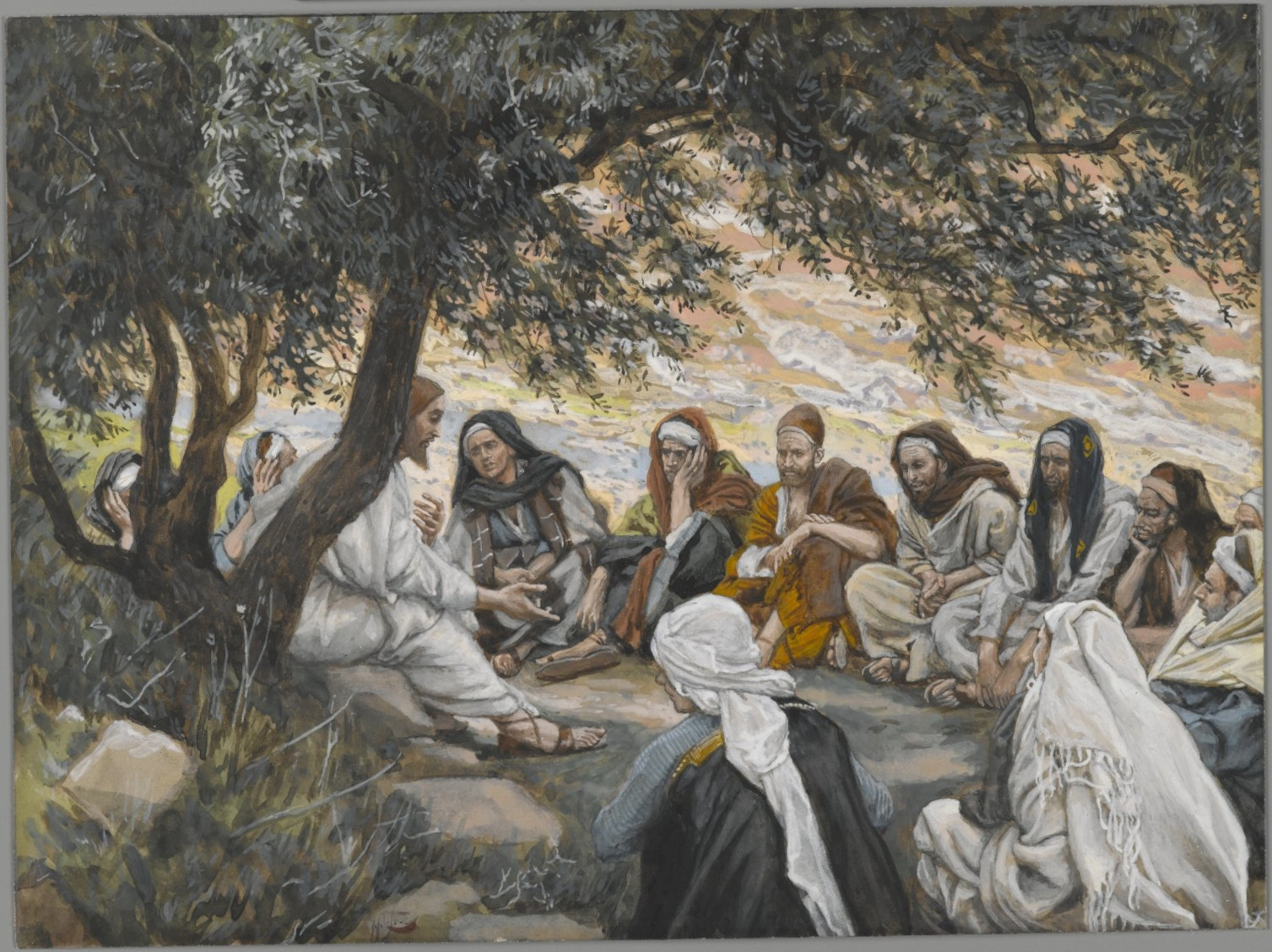
Image One: The Exhortation to the Apostles by James Tissot.  Wikipedia.  Public Domain.
 
Image Two: One of the Throne-Rooms of the Bavarian King by Gryffindor.  Wikipedia.  Public Domain.
 
Image Three: Christ Healing the Blind by El Greco.  Wikipedia.  Public Domain.

Monday, March 4, 2013

The Verses
 
13 Then some children were brought to Him so that He might lay His hands on them and pray; and the disciples rebuked them.
 
14 But Jesus said, "Let the children alone, and do not hinder them from coming to Me; for the kingdom of heaven belongs to such as these."
 
15 After laying His hands on them, He departed from there.
 
Why Children?
 
The fact that the people Jesus is blessing in this story are young children explains the disciples' reaction, and will come into play heavily in each of the facets of this story we'll soon discuss.
 
In American culture today, we tend to value children - parents, organizations, and all levels of government devote a large chunk of time and money to them.  But in Jewish society at the time of Jesus, the opposite was the case.  To be a child was to be pretty much the absolute lowest member of society - perhaps more valued than a prostitute or leper, but still regarded as wholly worthless.
 
So, Jesus sets out to change that, demonstrating that every human God has created is extremely valuable.
 
Contrasting the Ministry Leaders
 
Although most church paintings we're familiar with depict Jesus as always hanging out with only a handful of people (probably because it takes a long time to paint a person), reading through the Gospels reveals that He was constantly swarmed by crowds.  It's not like He was ever just wandering around looking for some way to pass the time in between miracles.  He was a celebrity, and people flocked to Him all the time.
 
So, that this Man, who is a national superstar, never has a moment's peace, and is actually God Himself takes the time to bless and handful of the lowest members of society.  And that action wasn't for good PR, like presidents kissing babies.  That's pretty radical.  Can you picture many famous Christian leaders today doing the same thing?
 
It seems to me that most of them (not all, most) would instead "invest" in the "more influential" people that would "make a difference."  It's not surprising, because that's exactly how the disciples reacted.  It's a form of favoritism shrouded under the guise of applying "practical business sense" to ministry.
 
But Christ has not called us to engage in "kingdom building" through carefully calculated methods that end up ostracizing the "less important" - He has called us to follow Him.  That is, He has called us to strive to live exactly as He did.  That means treating those who society labels as worthless like we would royalty.
 
The Flip-Side
 
On the other side of that same coin, a common sin that trips up many Christians happens when they are doing something for God (whether ministry work or reaching out to someone in their life or whatever).  When that Christian sees either God blessing that person's work more than their own, or church leadership giving more attention to that person, they can get very jealous.  And they can start to wonder why it's happening like that, since they think their work is more important, or will have more of an impact, or they're putting more effort into it, etc.
 
But we must guard ourselves from ever starting to think like that.  Perhaps our pride has blinded us, or perhaps that other Christian needs more support and more rapid results to keep them motivated to continue, so God has arranged circumstances in line with that.  Whatever God has called an individual to do is 100% as important as whatever He has called a different individual to do, no matter how important these two callings are from the human perspective.
 
To Such as These
 
We just recently covered this same topic of what it means to approach faith like a child, so you can visit that original post for a deeper discussion.  The crux of it is being humble, willing to please, and trusting.
 
In this, Jesus shames the disciples for not valuing the children by telling them that they need to become more like the children!
 
Practical Lessons
 
To quickly sum up, here's how we can apply these verses to our own lives:
  1. In order to truly live as Christ did, we need to take time the show His life not just to those who society labels as "important" or influential, but to the lowest of the low.
  2. If others are showing attention to those who our prideful natues consider "lower" than ourselves, we need to be diligent in an attitude-180.  We need to give up our perceived "right" to more attention.
  3. We should pay attention to how believers of lesser social station act (perhaps the poor, or the lesser educated, etc.), and learn from them.  The hardships they've suffered in the form of societal views very well may have given them a more Christ-like character, full of love and humility.  Luke 7:47 has the same feel (although it applies to genuine sin, not societal labels).
 
Anything that stuck out to you about this passage you'd like to share with the rest of us? :-)  Questions and comments are always welcome.
 
Image Citations:
 
1 - Jesus Christ with Children by Carl Bloch.  Wikipedia.  {{PD-1923}} Public domain in the United States.
 
2 - The Exhortation to the Apostles by James Tissot.  Wikipedia.  {{PD-1923}} Public domain in the United States.

Friday, January 11, 2013

He Values Us, and We Must Value Others- Matthew 18:1-14

And the Award Goes to...
 
1 At that time the disciples came to Jesus and said, "Who then is greatest in the kingdom of heaven?"
 
2 And He called a child to Himself and set him before them,
 
3 and said, "Truly I say to you, unless you are converted and become like children, you will not enter into the kingdom of heaven.
 
4 "Whoever then humbles himself as this child, he is the greatest in the kingdom of heaven.
 
5 "And whoever receives one such child in My name receives Me;"
 
The disciples had a tendency to ask questions about who was greatest or held the highest rank quite frequently.  Jesus later gave a more succinct answer, which He demonstrated here: "So the last shall be first, and the first last."  It is those who humble themselves before the Lord and are willing to forego worldly status who are most honored in God's kingdom - not those who are concerned with rank, like the disciples were doing here.  They had the 100% wrong focus (status, instead of Christ and His will), so Jesus humbled them with a vivid image: He took a human of the absolute lowest station in Jewish society at the time (a child), and told them to emulate him.
 
What does it mean to be like a child?  It's all about humility.  A well-behaved child will view himself and his wishes as not on the same plain as those of his parents and elders, and he will strive to please his parents.  In the same way, we are to submit wholly to God's will, seek to please Him with all of our hearts, and submit to those around us out of love.  Humble is a verb, not just an adjective - it's a choice we make, not a trait we're born with.
 
So, in verse 5, Jesus isn't only talking about literal children; He's talking about other believers, even (perhaps especially) those believers who are of lowly station by worldly standards.  James 2:1-12 deals with this issue in a powerful way, as the letter's original recipients were showing favoritism toward richer Christians and not welcoming poor Christians.  We can please God by humbling ourselves spiritually, and one way of doing this is to humble ourselves to help and associate with those who are humble in the worldly sense.
 
The Tempters
 
6 but whoever causes one of these little ones who believe in Me to stumble, it would be better for him to have a heavy millstone hung around his neck, and to be drowned in the depth of the sea.
 
7 "Woe to the world because of its stumbling blocks!  For it is inevitable that stumbling blocks come; but woe to the man through whom the stumbling block comes!
 
8 "If your hand or your foot causes you to stumble, cut it off and throw it from you; it is better for you to enter life crippled or lame, than to have two hands or two feet and be cast into the eternal fire.
 
9 "If your eye causes you to stumble, pluck it out and throw it from you.  It is better for you to enter life with one eye, than to have two eyes and be cast into the fiery hell.
 
10 "See that you do not despise one of these little ones, for I say to you that their angels in heaven continually see the face of My Father who is in heaven."
 
Normally when Christians talk about temptation, it is stated or implied that the source of the temptation is the demonic realm.  But this passage focuses on the two other sources of temptation we know to exist: the world (made up of other people) and our own flesh.  Also bear in mind that here again, "child" doesn't mean just a literal child, but any believer.
 
When we stumble another believer - through what we say to them (such as prompting them to anger against another), how we dress, how we act around them (such as consuming alcohol if we know they're a recovering alcoholic), etc. - it is a very, very serious issue.  That fact shouldn't be glossed over.  But at the same time, I don't think those verses (6-7) are actually a warning against believers' behavior (although there are other passages such as Romans 14 that deal with that issue).  Instead, these verses take the form of a curse against the world (similar to Matthew 11:20-24), and we also know that a believer tripping up another believer certainly does not incur eternal damnation.  So, the take-away from these verses for us believers is that the causing others to stumble is serious...but don't let the verses freak you out, either. :-)
 
It's also important to note that one of the reasons we humans fear humbling ourselves so much is that we think it will make us vulnerable - but in verses 6-7 and 10, it is abundantly clear that Jesus is very protective of us and has specific measures in place to protect us.  We need not fear surrendering to God.
 
Moving on to verses 8-9, note that they are not advocating for salvation through works - we do not "earn" salvation by living holy lives.  Trying to live as God wants us to as a response to His love is the evidence of genuine faith and repentance, yes, but it is an inherent reaction to the means (Christ's forgiveness), not the means themselves of obtaining forgiveness.  However, if we continue to allow sin to rule our lives and make no effort to break free of that and replace them with Christ as the Lord of our lives, that sin can very easily become our new god - and, as a consequence, we can fall away from the faith.  (Please note that struggling with sin and living in sin are two separate concepts.)  That is the warning here: We need to treat the sin in our lives seriously, and be active in turning our lives over to Christ.
 
Now, random body parts do not actually cause us to sin.  If they did, yes, it would certainly be worth it to sever them from our bodies to draw us closer to Christ, but Jesus was telling a sort of mini-parable here.  The hand, foot, and eye mentioned are whatever it is in your life that is a source of temptation to sin.  This could be a TV show, song, book, relationship, lifestyle, habit, hobby, etc.  And whatever it is, we need to make the conscious decision that Christ is more important than that, and give it up for Him.
 
Finally, in verse 10, Jesus pulled his points together by reiterating that we need to love those who the world sees as lowly.  The word despise means to consider as worthless - but we know that everyone has worth to God.  Therefore, one of the body parts we need to sever is our sense of worldly rank or social status.
 
Chasing Sheep
 
11 ["For the Son of Man has come to save that which was lost.]
 
12 "What do you think?  If any man has a hundred sheep, and one of them has gone astray, does he not leave the ninety-nine on the mountains and go and search for the one that is straying?
 
13 "If it turns out that he finds it, truly I say to you, he rejoices over it more than over the ninety-nine which have not gone astray.
 
14 "So it is not the will of your Father who is in heaven that one of these little ones perish."


Diving into this parable, let's clear something up right away: The shepherd abandoning the ninety-nine doesn't mean anything, it's just a part of the story - God never abandons us.  It's just a storytelling devise to portray just how much He values us.  We need to value the lowly because He values the lowly - and, from the standpoint of His Holiness, we are the lowly!  And yet, He is willing to put effort into drawing us to repentance, and He forgives us no matter how many times we stray (evidenced by how He rejoices when one returns to Him).
 
Now, this passage also brings up the issue of "once saved, always saved."  If you've read this blog for any amount of time, you know that my stance is that, yes, it is possible to lose your salvation (by willingly living in sin and stopping making any effort to have a genuine relationship with God).  See Hebrews 10:26-31 and Romans 11:17-24.  That pops up with this passage because the shepherd desires all the runaway sheep to return to Him, but only "finds" some of them (i.e. only some return to Him).  But the wonderful news is this: "It is not the will of your Father who is in heaven that one of these little ones perish."  This powerful statement is echoed in 2 Peter 3:9, and we know that absolutely nothing besides our own decision to run can rip us from the arms of God.  And if we run, but then come back to Him, He still loves us with all His heart.
 
Questions for You
 
Have there been times in your life when you have, or have not, extended God's love to someone who is of lowly station by the world's standards?
 
What "body parts" (entertainment, relationships, activities, etc.) have you severed from your life for Christ?
 
Has there been a time in your life when you abandoned your faith, only to return?
 
Anything else you'd like to add about today's passages, or questions you'd like to ask?
 
Giving Credit Where It's Due
 
Images 1 & 2: Courtesy of Sweet Publishing.  Used by permission.
 
Image 3: Suffolk Sheep Posing, by Jacquie Wingate.  Wikipedia.  Used by permission.

Saturday, December 8, 2012

Denominationalism, Hypocrisy, Scheduling, and Christmas

To use the Christianese phrase, God's really been putting something on my heart the past few days - He's been teaching me new things about my long-held approach to denominationalism (the practice of having multiple denominations, like Baptists, Lutherans, Pentecostals, Bereans, etc., within Christianity).  I'm going to talk about that today instead of posting a Bible study tip.

I'm going to be bold right up front, and if it offends or shocks you, please keep reading - I'll be attacking myself, too. ;-)

I believe that the American method of splitting the church into denominations is contradictory to Scripture - that it is anti-Biblical.  I believe that, for those Christians who do not have the same interpretation of Scripture regarding this issue as I hold, it is not a sin issue because they're not consciously doing anything wrong, but, that doesn't change the fact that (in my view) it has many extremely negative consequences.  These consequences damage the Church and inhibit witnessing to the lost.

Okay, hang with me.  Let's look at the Scripture that I base this belief off of:

1 Corinthians 1:10-13

Now I exhort you, brethren, by the name of our Lord Jesus Christ, that you all agree and that there be no divisions among you, but that you be made complete in the same mind and in the same judgment.  For I have been informed concerning you, my brethren, by Chloe's people, that there are quarrels among you.  Now I mean this, that each one of you is saying, "I am of Paul," and "I of Apollos," and "I of Cephas," and "I of Christ."  Has Christ been divided?  Paul was not crucified for you, was he?  Or were you baptized in the name of Paul?

The problem in this passage is that the Christians in Corinth were no longer using "Christian" as their way of identifying their beliefs - they were latching onto their favorite Christian leaders, and those leaders' personal doctrine.  This is exactly the case with the denominations today.  And I see it play out all the time - when a Christian is asked what religion they are, so often they don't say, "I'm a Christian," they say, "I'm a [insert denomination name]."  The fact of the matter is, we should all say "I of Christ"!!!  Christ is our identity, and the rest additions, not labels - they can describe our beliefs, but they should not be used to identify ourselves!

Alright, so what bad comes out of this?  Two consequence groups: (1) Division within Christ's Church, and (2) Appearance of division to unbelievers, which inhibits witnessing.  Let's start with number one.

Okay, division within the Church [when I say Church, I mean all Christians everywhere; when I say church, I mean a local group that fellowships together].  Recently, I have seen a missionary's account where she was lauding Christians who responded to a natural disaster overseas...only, she didn't say "Christians" - she said her own specific denomination.  I've also seen an organization offer free resources on how to share the gospel and disciple believers - but the large note at the bottom said it was only available to people who belonged to that specific denomination.  Saints, this is evil!  It breeds arrogance and hostility toward other believers - both of which are out-right sins.  And it prevents churches from working together to accomplish things for God's kingdom!

In addition, it negatively impacts our ability to share the gospel!  Many unbelievers don't see denominations as different forms of Christianity, they see them as different religions altogether.  They think that if Christians can't even agree with each other, why should they bother believing it?  Therefore, denominationalism may result in fewer people being saved from Hell.

BUT...

But, I also can understand why Christians throughout history have thought that splitting into denominations would be helpful and beneficial:

(1) Let's look at division for branches instead of denominations - Catholicism, Protestantism, and Orthodoxy.  I would lack all academic integrity to claim that the above 1 Corinthians passage doesn't apply to this division, because there is absolutely no Scriptural or logical reason I could claim that.  I fully believe that there are some Catholic Christians who are genuinely saved, some Protestant Christians who are genuinely saved, and some Orthodox Christians who are genuinely saved.  Yet, these types of Christianity are so radically different that, other than Christ alone, they have virtually nothing in common.  Saying one word - Catholic, Protestant, or Orthodox, is a quick way to explain so much about what you believe.  It's a major time saver.

(2) Branching off of this, there's the practicality of fellowship.  For example, a woman praises God with worship songs done with electric guitars and a man who praises God with worship songs done in Gregorian chant are unlikely to be able to attend the same church service and both feel edified.  Likewise, a woman who believes that no spiritual gifts exist today and a man who believes that every congregant should exercise his/her spiritual gifts at every church gathering are unlikely to leave the same church service both feeling edified.  Now, in both of these cases, Biblically, they should treat each other as brethren - as fellow believers - and they may even be good friends.  But this doesn't mean they'll attend the same church service.  So, by having denominational labels, a church makes it much easier for people to immediately identify which church would fit their worship and teaching style best.

(3) When you get to the absolute extreme ends of any doctrine, the two opposing sides view each other as absolute heretics, and follow the Biblical command to cut off fellowship with that who proclaim false teaching.  And the thing is, in at least some cases, one side is right.  But how do we know which one?  I don't have an answer - God alone knows which approach to every single doctrine ever is correct, because no man ever has or ever will have perfect doctrine.  So, in this case, denominational labels are a way of disassociating with perceived heresy.  That's a good thing - IF they're right.  It's a really sticky issue.

Okay, so we've looked at a Bible passage, at the negative consequences of denominationalism, and at the reasons why denominationalism may have been perceived as necessary.  Now I'd like to share how my own approach has changed.

I used to classify myself as "non-denominational" because of the Bible passage and negative consequences shared above.  But I've recently realized that in my mind, this view had shifted to me making "non-denominational" into a denomination, and I was growing arrogant and slightly hostile toward those who preached denominationalism!  In other words, in the name of the Unity of the Church, I was fostering Disunity!  That made me a hypocrite.  I've encountered a term that I can think of myself as to fix this mental shift, but unfortunately, the term means different things to different people.  The term is "pan-denominational" (pan means all).  Some people use this to mean all religions, and I do NOT mean that.  I mean all Christian denominations.  I mean that I will not reject any Christian who believes the basics of Christianity - things like the Trinity, that salvation comes through grace by faith in Jesus Christ alone, etc. (check out what I consider the core basics under the "About" tab) - and that I will continually strive to not take a divisive, arrogant, hostile attitude toward those who have different doctrinal views than I do on non-salvation issues.

But that still doesn't solve everything - there's still the imbalance between the negative and postive effects of denominationalism.  My personal view at this moment is that perhaps there's a happy medium where labels exist only for the purpose of simplifying whose church services you're most likely to mesh with, but without creating a divisive mindset among Christians and without creating the appearance of disunity to unbelievers.  Perhaps steps toward this would include identifying ourselves as "Christian" alone in conversation and not sticking to "church circles" where we only work together with identically-minded congregations.

Please feel free to share your thoughts.  What negative impacts of denominationalism can you think of?  What postiive impacts?  How can we fix these problems?  How can we overall balance the situation?  Do you have personal experience (good or bad) with denominationalism?
Your opinions are 100% welcome.  However, personal attacks on individuals or specific denominations will not be tolerated and I reserve the right to remove them - that will only breed division, which is the very thing I'm trying to prevent here!

Finally, on to a bit of "house keeping."  I'm on Christmas Break for a month, so I will be able to post much more frequently during that time period.  Here's the new schedule:
Mondays: Verse-by-verse Bible study in Matthew
Wednesdays: Personal commentary on a social issue or topical study
Fridays: Verse-by-verse Bible study in Matthew
Saturdays: Weekend post - combination of Bible study tip, Christian media review, song, etc.
Bear in mind that these posts will often show up in the late afternoons, unless I write it the day before and schedule it.  If checking back a few times on posting days to see when I get a post up drives you crazy, you can either: (1) Follow the blog if you have a Google account and regularly visit your Blogger dashboard, in which case my new posts will pop up there automatically, or (2) Follow by e-mail, in which case Blogger will send you an e-mail every time I put up a new post.  Both of these can be found on the right side-bar.

Finally, because it's the weekend and we're getting close to Christmas, I'd like to share a Christmas song you may not have heard before - "A Soldier's King" by Kenny Rogers.  I find it incredibly touching.