Showing posts with label Fear. Show all posts

Sunday, October 20, 2013

Leading up to the Tribulation: Matthew 24:1-14

The Scripture
 
1 Jesus came out from the temple and was going away when His disciples came up to point out the temple buildings to Him.
 
2 And He said to them, "Do you not see all these things?  Truly I say to you, not one stone here will be left upon another, which will not be torn down."
 
3 As He was sitting on the Mount of Olives, the disciples came to Him privately, saying, "Tell us, when will these things happen, and what will be the sign of Your coming, and of the end of the age?"
 
4 And Jesus answered and said to them, "See to it that no one misleads you.
 
5 "For many will come in My name, saying, 'I am the Christ,' and will mislead many.
 
6 "You will be hearing of wars and rumors of wars.  See that you are not frightened, for those things must take place, but that is not yet the end.
 
7 "For nation will rise against nation, and kingdom against kingdom, and in various places there will be famines and earthquakes.
 
8 "But all these things are merely the beginning of birth pangs.
 
9 "Then they will deliver you to tribulation, and will kill you, and you will be hated by all nations because of My name.
 
10 "At that time many will fall away and will betray one another and hate one another.
 
11 "Many false prophets will arise and will mislead many.
 
12 "Because lawlessness is increased, most people's love will grow cold.
 
13 "But the one who endures to the end, he will be saved.
 
14 "This gospel of the kingdom shall be preached in the whole world as a testimony to all the nations, and then the end will come."
 
The Temple
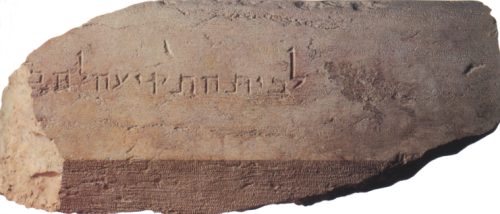


(Image believed to be one of the stones from the Temple!  "To the Trumpeting Place" by Talmoryair.  Wikipedia.  Public Domain in the United States.)

The prophecy of the Temple's destruction was fulfilled only a few decades later, in 70 AD.

This event certainly had significance for the Jews at the time - it was another step, like the veil of the Holy of Holies tearing in two at Christ's death (Matthew 27:51), demonstrating that Judaism was no longer the way to serve God, and that His dwelling place on Earth was no longer a physical building, but in His followers themselves (1 Corinthians 3:16).

But the disciples' questions about the End Times show that they picked up on some apocalyptic significance, as well.  This gets into kind of the mind-bending principle that even though we classify the "End Times" as the 7-year Tribulation of Revelation that is yet to come, the "End Times" basically actually started in Acts.  For example, the prophecy of the indwelling of the Holy Spirit identified as fulfilled in Acts 2:16-21 is also End Times in nature.  But what's significant about the Temple's destruction in terms of the End Times is that it marked a critical event in Roman persecution of the Jews - and of Christians, who were considered a Jewish cult by the Romans.  This corresponds with the fact that, throughout history, Christians around the world have been persecuted - something that will intensify more and more as we get closer to the Tribulation.

Brief Elements
 
How are the false Christs manifested?  Well, in 20th century America we have certainly seen some famous cult leaders literally claim to be Christ and amass followings, and I believe we may see a lot more of that as it gets even closer to the Tribulation.  But we've also seen people presenting false Christs - such as in the "Christian" cults of Mormonism and the Jehovah's Witnesses, who preach a Jesus and a Gospel totally different than the true ones.  And, there have been other religions such as Islam to develop and gain popularity that offer a different identity of God - another type of false Christ.
 
Next, the passage mentions rampant wars, famines, and earthquakes.  There are two ways to look at this: (1) that these will intensify as the world gets closer to the End, and (2) that they will accomplish the "agenda" of the End Times.  It seems to me that both have turned out.  For example, we've had two world wars in the past century, and major natural disasters certainly seem to be escalating (although I don't have statistics on that).  But as for the second way, the End Times are all about demonstrating judgment and bringing people (with emphasis on the Jews) to repentance.  We can certainly see how wars and disasters throughout history could be used to accomplish these objectives.
 
But let's take a moment to step back and look at what Jesus said about how we should react to seeing these things:
  • We are to not fear.  We need to remember that even if the world is consumed by war, if natural disasters shatter our nations, and if people seek to kill us because of our faith, that God is still in control.  Easier said than done, obviously, but if we train our minds to remember that God is in control when "little" things go wrong in our lives now, it will be a far more natural reaction when the sky starts to fall.
  • We are to keep it all in perspective - there are so many "birth pangs" leading up to the "actual" End that we shouldn't freak out that "The End is nigh!" every time a flood happens or some country threatens to nuke the world.  That doesn't mean that we shouldn't be psychologically prepared for the possibility of the End Times occurring during our lives, or that we shouldn't actively engage in staying attentive to world events and comparing them with Biblical prophecy, but it does mean we shouldn't go crazy.  That only makes people think that Christians are all morons when the End doesn't happen right away - and that can prevent them from coming to Christ themselves.
  • We need to stay resolute in our faith.  More on that directly below.
The Great Apostasy
 
We Americans are disgustingly unaware of the persecution of our brothers and sisters around the globe, but frankly, outside of the Western World, it's quite rampant.  And there are certainly many cases where people renounce their faith because of the persecution.  Persecution of Americans has already started on small scales - Christian businesses have been fined for refusing to provide abortion pills to their employees, and we can get fired, suspended from school, and even arrested for "hate speech" for speaking God's Truth.  But one day, probably sooner than many people think, global persecution of the Church will arrive - and that includes America.  If the authorities showed up at your door today ready to cart you off to prison on the charge of being a Christian - would you proclaim your faith in Him?  If the punishment were death - would you still proclaim your faith in Him?  We can all flippantly say, "Well, yeah, of course" - that's easy because we don't really think that will happen.  But think it through - right now.  Vividly imagine that scenario.  Picture the handcuffs.  Picture the prison.  Picture the beatings.  Picture the noose, the electric chair, the firing squad.  Then ask yourself again: Would you claim Him, or deny Him?
 
 
But there's another thing still that drives people to fall away, an evil strong and active in the West right now: apathy.  The Church is lukewarm, claiming Christ but not living it out.  It accepts fornication, freely uses God's Name in vain, and is lazy, encouraging Christians and "Christians" to pursue their own lives with God on the side, rather than making every education choice, career choice, and relationship choice centered on Him.  Because lawlessness is increased, most people's love will grow cold.  Evil and apathy are rampant, and the Western Church clings to the abominable lie that we have a "right" to a "normal life" - and that "God understands" this.  Friends, that is evil.  If a person couldn't look at a random day of your life and tell that you are not just a "Christian" in the American sense of the word, but that you passionately believe it with every fiber of your being, something is wrong.
 
We cannot stay strong for Christ on auto-pilot - it is a daily war against the flesh, the evils of this world, and Satan's forces.  There can be no resting from it until the day we are called home.
 
The Gospel to All Nations
 
One of the prerequisites to the literal, official End is for every nation to hear the Gospel.  I can't locate exact information at this time, but last I heard, all we have left is a few pockets in Asia and Eurasia.  In other words: It's almost fulfilled!
 
But this brings up another important issue: What about the people who have never heard the Gospel - how is it "fair" that they go to hell when they've never had a chance to get saved?  Well, even though God likes to use us to spread His Good News (primarily for our sake, I believe, as it gives us a purpose and helps us mature in our faith), it's not as if He's limited to only using human words to bring people into a saving relationship with Him.  Romans 1:20 explains that God reveals the Truth about Himself through nature, and elsewhere Scripture makes clear that if someone is truly seeking God, He will reveal Himself to them, no matter if a missionary is around.  In fact, there have been multiple cases in the Middle East where Muslims have sought the True God, and God revealed Himself to them in dreams.  There will indeed be people from every tongue and tribe and nation from throughout history in Paradise.
 
What, then, is the point of the Gospel being verbally preached to all nations before the End can come?  I believe it's largely symbolic - that God's purpose for the world has been accomplished completely, at long last.
 
Any comments you'd like to add - insight, thoughts, further Scripture references?
Or any questions about this passage (or anything about the Bible or Christianity) you'd like to ask?
Then leave a comment below. :-)  Or you can e-mail me questions, if you prefer.
 
Don't know Christ as your Lord and Savior yet?  Click here to learn how in English or here to learn how in your own language.


Friday, January 4, 2013

Learning Lessons Again and Again: Matthew 17:22-27

Reactions to the Crucifixion
 
22 And while they were gathering together in Galilee, Jesus said to them, "The Son of Man is going to be delivered into the hands of men;
 
23 and they will kill Him, and He will be raised on the third day."  And they were deeply grieved.
 
The three gospels that record this encounter all shed different light on the disciples' reactions to His statement, so let's read the other two before diving in.
 
Mark 9:30-32
From there they went out and began to go through Galilee, and He did not want anyone to know about it.  For He was teaching His disciples and telling them, "The Son of Man is to be delivered into the hands of men, and they will kill Him; and when He has been killed, He will rise three days later."  But they did not understand this statement, and they were afraid to ask Him.
 
Luke 9:43-45
And they were all amazed at the greatness of God.  But while everyone was marveling at all that He was doing, He said to His disciples, "Let these words sink into your ears; for the Son of Man is going to be delivered into the hands of men."  But they did not understand this statement, and it was concealed from them so that they would not perceive it; and they were afraid to ask Him about this statement.
 
If we had only looked the Matthew account, we could have arrived at the mistaken interpretation that the disciples were grieved because they "got it," because they were sad because they understood that their Teacher would be murdered.  (That's why, whenever you run across a passage in the Gospels and you realize that your interpretation is based on brief wording or limited details, it's important to check if that story is also in other Gospels.)  But this isn't the case at all - they didn't understand.  Rather, they were grieved because they vaguely suspected that He was speaking literally (as opposed to symbolically in parables as He so often did), and they were afraid of what His answer would be if they asked for clarification.
 
On a personal level, I can relate to the disciples.  There have been times when I've felt that God might want me to do something or that the Holy Spirit was leading me toward a hard-to-stomach doctrine (I mean, think of all the controversial and emotional issues in Scripture revolving around the End Times, predestination, the souls of aborted babies, etc. - there's a lot that's hard to think about!), but I wasn't yet able at that point to ask Him directly for the answer, because I wasn't ready.
 
In this disciples' case, perhaps they would have been able to handle the crucifixion better when it actually happened if they had been able to accept it sooner, at least in part.  The fact that Jesus told them He would be killed over and over and over again - a way of preparing them for the event (among serving other purposes) - makes me think that likely.  So, when we feel the Holy Spirit is pursuing us about some issue but we aren't yet able to handle it, we should (1) pray for God to continue to prepare our hearts to accept it, and (2) continue to actively think about it to acclimate ourselves to the issue instead of hiding from it.
 
But there's also the matter of why they didn't understand that complicates the issue: God concealed it from them.  Why?  Well, I don't think it was a matter of hardness of heart like we see in other Biblical cases where God conceals understanding from someone.  Rather, I think He knew they couldn't handle the whole truth yet.  I mean, come on - imagine your best friend, your mentor, and your Messiah (who you thought would throw off Roman government and reestablish Israel for all time right then [as opposed to at the End of the Age, when we know it will take place]) telling you that He would be tortured and executed...that's a lot to take!  So, since they weren't in a place where they could accept it yet, He concealed the whole truth from them, not forcing the entire revelation on them, while allowing the "small bites" to penetrate their spirits and slowly grow into a more developed understanding.  He was protecting them by concealing the whole truth of the matter from them.
 
Another Case of Rather Be Wronged
 
24 When they came to Capernaum, those who collected the two-drachma tax came to Peter and said, "Does your teacher not pay the two-drachma tax?"
 
25 He said, "Yes."  And when he came into the house, Jesus spoke to him first, saying, "What do you think, Simon?  From whom do the kings of the earth collect customs or poll-tax, from their sons or from strangers?"
 
26 When Peter said, "From strangers," Jesus said to him, "Then the sons are exempt.
 
27 "However, so that we do not offend them, go to the sea and throw in a hook, and take the first fish that comes up; and when you open its mouth, you will find a shekel.  Take that and give it to them for you and Me."
 
Let's start with the minor, tangential point about how Jesus knew what had transpired with Peter before Peter even said a word.  There's not really much to expand on, I just love highlighting it because it's one tiny demonstration of how truly awesome our God is.  I always wonder if Peter was so used to Jesus doing that that it didn't amaze him anymore, of if he was still swept off his feet every time...
 
Anyway, the tax referred to in this passage wasn't actually one from the Roman government - it was the temple tax.  Its origin can be found in Exodus 30:12-14; think of it sort of like how in Mormonism, tithing isn't optional or self-motivated (as it is in most Christian denominations), it's mandated and regulated to the point of having to turn in tax forms.  So the point is, the tax-collectors in this story worked for the temple - presumably as representatives of God's kingdom.
 
You see, in this little analogy, the Father is the King and the Son is, well, the Son.  Because it's a tax for God's temple, the Son is legally exempt.  But Jesus chooses to reiterate a point He made back in Matthew 5:38-48:  We should be willing to sacrifice our own interests, should rather be wronged than wrong, in situations where that will bring glory to God and reflect well on Him.  Because the tax-collectors believed that it would be wrong of Him not to pay the temple tax, He paid it to avoid tripping anyone up.
 
(Note, however, that this should not be extrapolated into "saying" that you should give money to, for examples, charities that you know will misappropriate the funds.  The point is to glorify God by sacrificing your own interests, not giving money to any organization that asks for it.)
 
The bit about finding the tax money in the fish's mouth is important, too.  It seems like kind of a weird miracle (and we're not given any indication why it was in a fish's mouth of all places - the only connection is that Peter was a fisherman by trade), but the more important point of the matter is that God provides.  Since Jesus was paying the tax, Peter had to, too - and notice that, in travelling to the water and going fishing, he still had to work, still had to sacrifice something.  But, God helped him.  Whenever God asks us to do something we absolutely, positively cannot do, He will provide a way to accomplish it.
 
Questions for You
 
When in your life have you been afraid of the answer God might give?
 
What little instances (like paying the temple tax above) have been in your life where you've had to sacrifice something to reflect well on God?
 
Any insights you'd like to add to our study?  Or questions you'd like to ask - either something I wasn't clear about, or a detail I didn't cover, or a tangential topic branching off of today's study?
 
Giving Credit Where It's Due
 
Image Number One: The Exhortation to the Apostles, by James Tissot.  Wikipedia.  Public domain in the United States.
 
Image Number Two: Giant Grouper, by Diliff (edited by Fir0002).  Wikipedia.  Used by permission.


Wednesday, December 26, 2012

Is Self-Defense Biblical?

Is it Biblical to defend yourself if you're attacked?  I say YES - but (1) this answer kind of changes in the specific situation of persecution, and (2) we must always still love and forgive the attacker.  Now, let's dive into the Scriptures and explore this issue.

The Most Commonly Slung Passages in This Debate

Let's start with one of the most often cited verses when this issue is brought up, Matthew 5:38-9: "You have heard that it was said, 'AN EYE FOR AN EYE, AND A TOOTH FOR A TOOTH.'  But I say to you, do not resist an evil person; but whoever slaps you on your right cheek, turn the other to him also."  The problem with applying this verse to modern self-defense is that, while slapping someone in the face may count as physical assault in American culture, in Jewish culture at the time of the New Testament (and in many other cultures throughout history), slapping someone in the face was just an insult.  Furthermore, if you read the entire passage for this verse as context, none of the examples have to do with physical danger; the theme that emerges is that even when someone does something unjust to you (in this passage, the examples are insulting you with that slap, suing you in court, and the Roman government demanding extra work from you [kind of like a physical tax]), you are not to retaliate.  Now, if - and I mean IF - other Scripture established the notion that this principle also applied to someone trying to murder your or rape you or beat you to a bloody pulp so they could steal your wallet, this passage would be highly relevant.  But since I don't believe Scripture does that (as I will demonstrate with Scripture throughout this post), this verse simply doesn't apply to the specific issue at hand: self-defense from a physical attack.

Another passage that pops up frequently in debates about this topic is Luke 22:35-38: "And He said to them, 'When I sent you out without money belt and bag and sandals, you did not lack anything, did you?'  They said, 'No, nothing.'  And He said to them, 'But now, whoever has a money belt is to take it along, likewise also a bag, and whoever has no sword is to sell his coat and buy one.  For I tell you that this which is written must be fulfilled in Me, "AND HE WAS NUMBERED WITH THE TRANSGRESSORS"; for that which refers to Me has its fulfillment.'  They said, 'Lord, look, here are two swords.'  And He said to them, 'It is enough.'"  [Notice that this is a reversal of Jesus's command to the disciples found in Matthew 10:5-14, Mark 6:7-13, and Luke 10:1-12 - because the situation had changed from Jesus's initial ministry to the Jews to worldwide evangelism in a world where Jesus had been crucified.]  Proponents of both sides of this issue actually use this passage to support their polar-opposite positions!  I'll simply say that this is what I see in it:
  • This issue is all about BALANCE.
  • We are given permission to provide for and defend ourselves because we are living in a very, very dangerous world (i.e. we are living among transgressors).
  • But we are still, above all else, to go out among the world and preach the Gospel - the sword (weapon) is one tool to help us carry out that mission (by keeping us alive), but our focus, our purpose, and our intent is to serve Christ above all else - that's made explicit by what He's referring to in referencing His previous instructions upon sending them out.  The sword is not the main point of this passage, so when examining that one facet, we must keep the main point in mind.
  • From the entirety of Scripture, we find that we are to both act ourselves and depend on God fully.  When you are unable to (in this case) take measures to defend yourself, trusting God to protect you demonstrates admirable faith - but if you refuse to because you "trust" God to protect you, that very well could be putting God to the test (see Matthew 4:5-7), and His plan might be to not protect someone who treats His providence so flippantly.  Yes, God can protect anyone even if they are an unarmed cripple against an army of a million, but they way He chooses to protect someone in a given situation very well may be to use human beings, even that human being trained or armed or whatever, to bring about that protection. (Psalm 18:34)
  • We are NOT to engage in "Holy War" (see John 18:36).  Defending your own life or the life of another is totally different from going out and threatening to kill people if they don't "convert."  Additionally, "Holy War" is pointless - you simply cannot force someone to come to genuine faith in a loving God by holding a gun to their head.  It's stupid, it's pointless, and it's utterly evil.
  • Finally, I want to address why Jesus said, "It is enough."  My personal interpretation is that He was saying those two swords were enough for that specific situation they found themselves in at that moment (Gethsemane), because (1) obviously, they didn't exactly have time to go buy more right then, (2) evidenced by the fact that they yanked out swords the instant He said that, the disciples apparently got a bit freaked out and were preparing for a conflict right then, and (3) branching off of that, Jesus did not intend Gethsemane to turn into a battlefield because being crucified was His very purpose for coming to Earth.

Scattered Examples
 
More potentially applicable material can be found in Ephesians 5:25-33, which lists off how husbands should treat their wives, including "Husbands, love your wives, just as Christ loved the church and also gave Himself up for her...So husbands ought also to love their own wives as their own bodies."  In this, it seems to say that husbands should be willing to die to protect their wives (and, given the culture in which that was written, it was not meaning in the context of joining the military).  Consider that defending your family is an issue that pops up frequently in American discussions of self-defense.
 
In the Old Testament, the books of Ezra and Nehemiah (in which the captive Israelites are rebuilding Jerusalem and its temple) provide examples of how, in a non-war context, men arm themselves to defend themselves and their families from persecutors.
 
This latter case is where I believe the common Biblical warning of "Live by the sword, die by the sword" comes into play: If you have a warrior mentality that prompts you to defend others, you won't necessarily receive supernatural protection - your calling, which you are willingly following, may be to give your life for others.  It's Biblically identified as a noble sacrifice.  So don't confuse the line "Live by the sword, die by the sword" (which is used in multiple contexts, as are other Biblical sayings) as always being a bad thing.
 
So What About Persecution?
 
There definitely needs to be made a distinction between fighting back against a murderer and a persecutor - i.e., why they're attacking you: because of your faith, or for some other reason.
 
Biblically, I don't see any reason at all why you can't defend yourself in a non-persecution situation (in fact, I see some indications that you are definitely allowed to).  But, as for situations involving persecution, I can understand why there's a debate.
 
I mean, because the New Covenant changed the rules of how we are to relate to unbelievers, Old Testament examples don't hold much weight in this case.  And there isn't a single New Testament example of a Christian fighting against persecutors (fleeing, yes, but not engaging in combat with a persecutor).  And, we know that persecution is good for the Church because the examples of the saints (by willingly bearing persecution by loving the persecutors and not fearing death) are so powerful.
 
So, when it comes to persecution, I won't tell you that you can't defend yourself, but I won't tell you that you can, either.  Study this issue out for yourself, and follow the leading of the Holy Spirit.
 
What are your musings and insights on this issue?  Share your thoughts by leaving a comment.

Tuesday, July 31, 2012

How Will You Respond? - Matthew 8:28-9:8

Demons in the Pig Pen

28 When He came to the other side into the country of the Gadarenes, two men who were demon-possessed met Him as they were coming out of the tombs.  They were so extremely violent that no one could pass by that way.

29 And they cried out, saying, "What business do we have with each other, Son of God?  Have You come here to torment us before the time?"

30 Now there was a herd of many swine feeding at a distance from them.

31 The demons began to entreat Him, saying, "If You are going to cast us out, send us into the herd of swine."

32 And He said to them, "Go!"  And they came down and went into the swine, and the whole herd rushed down the steep bank into the sea and perished in the waters.

33 The herdsmen ran away, and went to the city and reported everything, including what had happened to the demonaics.

34 And behold, the whole city came out to meet Jesus; and when they saw Him, they implored Him to leave their region.

Okay, so these two demon-possessed men are coming out of the tombs...does that mean that the demons are reanimating corpses?  In this case, the answer is, very fortunately, no.  Mark 5:2-3 clarifies that these men were living in the wild where the tombs were.  So, they were'nt undead, but it's still a vivid picture of how Satan's kingdom is one of death. 

One more quick clarification - Matthew says there were two demon-possessed men here, but when the story is told in Mark 5:1-20 and Luke 8:26-39, only one man is mentioned.  Is this a contradiction?  No.  If there were two men there, it's also true that one man was there.  Mark and Luke just chose to focus in on one of the men, seemingly the one who was in much worse condition since he had more demons in him.

"They were so extremely violent that no one could pass by that way."  Here's what impresses me: Jesus wasn't scared of them at all.  Here they were, lashing out a people with super-strength (see the above hyperlinks to the passages in Mark and Luke), but Jesus walks right up to them.  Why?  Because He knows He has no reason to fear them since God had given Him authority over them.  Did you know that we have the same authority?  Mark 16:17 tells us, "These signs will accompany those who have believed: in My name they will cast out demons, they will speak with new tongues..." and Luke 10:19-20 reads, "Behold, I have given you authority to tread on serpents and scorpions, and over all the power of the enemy, and nothing will injure you.  Nevertheless do not rejoice in this, that the spirits are subject to you, but rejoice that your names are recorded in heaven."  I realize that, as someone who has never cast out a demon or even seen someone acting "demon-y," this is easy for me to say.  But the Word of God still stands: we as believers do not need to fear.

Now, people teach verses 29-32 in a lot of different ways.  ***This is just my take on it.***  What the demons fear is being sent straight to hell instead of being allowed to roam the earth (Luke 8:31 puts this bluntly).  Interesting that they fully acknowledge their power and authority of God (also see James 2:19), yet they're still clearly unrepentant - I mean, they were just causing trouble by possessing a guy!  How often do we make the same error - believing in God, yet refusing to repent and live for Him?  Belief isn't enough - He wants a relationship.  Check out this post for more on that.

But back to what's going on with the demons entering the swine.  I see two possible scenarios.  (1) The demons want to cause trouble by killing the pigs so the people will chase Jesus out of town.  It seems ridiculous that demons would be stupid enough to think that they can pull one over on the God who can force them to act with one word...yet isn't that Satan's entire game plan?  If this scenario is what's going on, then having to leave town is within God's will for Jesus.  (2) Jesus intends to send them into the abyss, anyway, since the sea is thought to be some sort of extra demonic realm (see Revelation 20:13).  This demonstrates His ultimate power over them.  In this case, too, having to leave town is part of His plan.

Now let's look at the people's reaction to this event.  Luke 8:35 tells us, "The people went out to see what had happened; and they came to Jesus, and found the man from whom the demons had gone out, sitting down at the feet of Jesus, clothed and in his right mind; and they became frightened."  They could have feared any number of things, including His power, the loss of more of their material possessions, and a riot.  They allowed fear to prevent them from caring about these men who were freed from possession and from seeking God's salvation.

Healing a Paralytic: Everybody's Surprised

1 Getting into a boat, Jesus crossed over the sea and came to His own city.

2 And they brought to Him a paralytic lying on a bed.  Seeing their faith, Jesus said to the paralytic, "Take courage, son; your sins are forgiven."

3 And some of the scribes said to themselves, "This fellow blasphemes."

4 And Jesus knowing their thoughts said, "Why are you thinking evil in your hearts?

5 "Which is easier, to say, 'Your sins are forgiven,' or to say, 'Get up, and walk'?

6 "But so that you may know that the Son of Man has authority on earth to forgive sins" - then He said to the paralytic, "Get up, pick up your bed and go home."

7 And he got up and went home.

8 But when the crowds saw this, they were awestruck, and glorified God, who had given such authority to men.

You may be familiar with the longer account of this healing in Mark 2:1-12 and Luke 5:17-26 - it's the one where the paralytic's friends lower him through the ceiling to get to Jesus because they can't make it through the crowds.  Now, why does Mark identify this as taking place in Capernaum, since Matthew says it's Jesus's own city...wouldn't that be Nazareth or Bethlehem?  Actually, Jesus made Capernaum his sort of "base of operations."
One thing I find amazing about this story is that Jesus saw their faith...this means He saw the friends' faith, as well.  They had so much faith in Jesus's power to heal their friend, and so much love for their friend, that they were willing even to tear the roof of this house - knowing that they would likely get yelled at for doing so and have to pay for/do the repairs themselves.  Also, in none of these accounts does the homeowner get angry with them.  It is possible that he did and the Bible just doesn't mention it, but judging by the fact hta the was willing to let all these people congregate in his home to see Jesus, I'd wager that he didn't mind.  Talk about amazing compassion for a stranger!  This is a beautiful example for us.

I love the order in which Jesus responds.  He heals the man's soul first - because that is indeed His first priority, and the most important thing.  But He also has mercy on the man's physical condition, as well as takes the opportunity to prove His power (gotta love that spunk).  How often do we ask God to fix things in our lives, but not in our hearts and souls?  We know what His priority is...what is ours?

Finally, let's look at everyone's reactions.  The scribes: They reject Him - He threatens the status quo and their station among the people.  He shakes things up in their lives, and they don't like that.  The crowds: They rejoice!  They praise God for His mighty works and for dwelling with them.  The paralytic: This one is my favorite. :-)  He obeys perfectly.  God has blessed him tremendously, but rather than using that blessing to do whatever he wants, he uses it to do exactly what God wants him to use it for.  How will you react today - like a scribe, or like the paralytic?

The Ultimate Response

We've talked a lot today about people's reactions to Jesus.  What is yours?  If you have not ever entered into a relationship with Jesus, now is the time to do so - do not delay!!!  Click here or the "How to Receive Salvation" tab above to find out how.

He's waiting for you - what's your answer?

Questions for You

Do you see the story of the demonaic differently (there are many takes; share yours!)?  How have you responded in the past when God blessing someone else required something of you, whether it be time or something material (like the herd and roof)?  Share these, and any other questions and comments, by leaving a comment. :-)

Giving Credit Where It's Due

Picture Number One: Medieval manuscript illumination, Christ Exorcising the Gerasenes Demonaic.  Wikimedia Commons.  {{PD-1923}} Public domain in the United States.  {{PD-old}} Public domain in European Union.

Picture Number Two: Christ Healing the Paralytic at Capernaum by Bernhard Rode.  Wikimedia Commons.  {{PD-1923}} Public domain in the United States.{{PD-old}} Public domain in Germany.

Thursday, July 26, 2012

What Kind of Man Is This? - Matthew 8:23-27

Master of the Sea
23 When He got into the boat, His disciples followed Him.

24 And behold, there arose a great storm on the sea, so that the boat was being covered with the waves; but Jesus Himself was asleep.

25 And they came to Him and woke Him, saying, "Save us, Lord; we are perishing!"

26 He said to them, "Why are you afraid, you men of little faith?" Then He got up and rebuked the winds and the sea, and it became perfectly calm.

27 The men were amazed, and said, "What kind of man is this, that even the winds and the sea obey Him?"

Let's start with Jesus sleeping.  I see three cool things we can glean from this one detail: (1) It demonstrates again that He was a man just like us, and experienced all the things we do - including being exhausted. Interestingly, it seems like when we're exhausted, we get grouchy and are more prone to sin - yet in His exhaustion, Jesus obeyed the Father's will and performed a miracle.  What kinds of things could we accomplish for the kingdom if we stayed tuned in with God, even when we're tired? (2) From what's been going in the verses preceeding this passage, I'd say He was exhausted from ministry.  We see this a lot in the Gospels (a poigniant example is Mark 6:31-34).  It's a beautiful picture of His love for us, and an example as well: we, too, ought to be so passionate about working for the kingdom of God and ministering to others that we continue long after we're tired.  (3) Jesus had a complete lack of fear.  He knew that nothing could hurt Him outside of the Father's will, so He saw no reason to waste time thinking about it.  Easier said than done, yes, and there is such a thing as a Holy fear (see this post for much more on that topic), but it is a goal we should all strive toward.

I also find it very interesting that the disciples knew Jesus would save them, yet were still totally surprised when He did.  It reminds me a bit of when the man in Mark 9:24 cries to Jesus, "I do believe; help my unbelief."  For this reason, and because of what else we know of Jesus's character, I don't believe He was stern with them in verse 26; rather, I think it was also meant to comfort them.  Our God is an immensely loving God, and I fully believe that He has compassion on us when we come to Him simultaneously trusting and afraid.

Now, what's going on with the sea? It could very well be a natural threat that God used for His glory - we all live in a world where storms and natural disasters happen, so of course Jesus experienced them, too.  But some interpret the wording of Revelation 20:13 as hinting that the sea serves as an extra holding place for souls and therefore has some sort of demonic presence.  In either case, though - demons or simply the earth - this demonstrates God's immense power.

So what does "rebuke" actually mean?  The original Greek word is epitimao, which means, "to honor, to mete out due measure, thus to censure."  Okay...censure isn't exactly a common word in English anymore...what does that mean?  "Strong or vehement expression of disapproval."  So, Jesus is first of all acknowledging this storm's power and asserting His own power over it, and He's really going at it.  Remember, this is the VOICE OF GOD (see John 18:4-6 - which references Exodus 3:13-14 - and all the times He healed someone or cast out a demon with just a word, on His own authority).  So, He stands up on a violently rocking boat, when all the disciples are huddled down, amidst a raging gale with powerful waves washing over the boat, and sharply reprimands it with three words (Mark 4:39), and everything...just...stops.  Can you picture the level of amazement the disciples were experiencing now? :-)

What kind of man, indeed...
The God-Man!  Let's look at a couple Psalms telling of God's power over the sea:

Psalm 89:9
You rule the swelling of the sea;
When its waves rise, You still them.

Psalm 93:4
More than the sounds of many waters,
Than the mighty breakers of the sea,
The Lord on high is mighty.

Let's Make It a Discussion!

We all have "I do believe; help my unbelief" moments.  What have been some of yours?

Jesus calming the storm and walking on the sea are my all-time favorite examples of God's power, since I'm fascinated by the immense power of churning water.  What are some of your favorites?

Share these, and any other questions or comments, by leaving a comment. :-)

Giving Credit Where It's Due

Image One: The Storm on the Sea of Galilee by Rembrandt.  Wikimedia Commons  {{PD-1923}} Pubic domain in the United States.  {{PD-old-100}} Public domain the European Union.

Sunday, July 8, 2012

Putting It All Into Perspective - Matthew 6:19-34

Money, Money, Money

19 "Do not store up for yourselves treasures on earth, where moth and rust destroy, and where thieves break in and steal.

20 "But store up for yourselves treasures in heaven, where neither moth nor rust destroys, and where thieves do not break in and steal.

21 for where your treasure is, there your heart will be also.

22 "The eye is the lamp of the body; so then if your eye is clear, your whole body will be full of light.

23 "But if your eye is bad, your whole body will be full of darkness.  If then the light that is in you is darkness, how great is the darkness!

24 "No one can serve two masters; for either he will hate the one and love the other, or he will be devoted to one and despise the other.  You cannot serve God and wealth."

I see this passage making two arguements against the pursuit of riches: it's pointless, and it's evil.

Let's look at pointlessness first.  Think of all the things that can happen to wealth: your stocks can crash, a natural disaster can wipe out phsyical property and overrun insurance can't cover it, a thief can steal it (physically or electronically), the ecomony can crash and your money will be worthless.  Or, you could just die, and then it's completely worthless to you.  With all the time and energy devoted to wealth, how is it worth it?  Talk about a wasted life!

The other side is that the pursuit of wealth is idolatry, because money will take God's place in your life.  How?  A few ways: your TIME (time spent working overtime, researching stocks, etc. that you could spend studying the Bible, praying, or in ministry), your FOCUS (every extra second spent thinking about money is one less second spent thinking about God and how to show His love to others), and your PERSPECTIVE (by always thinking about money, you'll start to think in terms of the physical world and forget that this is just one tiny portion of eternity).

Now, what's this whole "eye is the lamp of the body" talk?  To be honest, this verse has baffled me for years, but I think I'm *finally* starting to figure it out...maybe. :-)  Here's what I *think* it means...  Back in the time when this was written, after the sun set, you had to carry a lamp around with you to see things.  So, whatever you shined its light on was what you saw - and only that.  So, if your eyes (literal and spiritual) are focused on the things of this world, that's going to permeate your whole life, but if you're focused on the things of God, He is going to permeate your whole life.  Moreoever, if your lamp is somehow bad (like if the sides are dirty and clouded or cracked), you're going to get a skewed picture of reality.  Likewise, looking at the world through bad eyes (eyes focused on the non-eternal) is going to give you a skewed picture of reality.

Now, while we're on the subject of wealth, I want to talk a bit about our culture of consumerism.  I know from personal experience how hard it is not to get sucked in - trust me, I struggle with it every single day of my life!  We are surrounded by a million messages telling us that it's normal to want more, that we need more, that it's our right to have more.  Clothes, entertainment, expensive coffee drinks, the newest iWhatever...we waste SO much money on things that don't matter!  People have lived in huts with just the clothes on their back, eating the cheapest food they can find, for thousands of years...how dare we insinuate that we *have* to have more just to live a "normal human life"?  I am here and now making a commitment to seriously rethink my budget and commit more of it to eternal things.  Will you join me?

One more rant before we move on to the next passage of Scripture. :-)  There are some denominations, authors, and speakers out there who claim that God wants you to be rich, that being rich is evidence that you are a good Christian, and pray for money more often than anything else.  This is a completely anti-Biblical, despicable, and sinful teaching.  God sometimes blessed His followers with wealth in the Old Testament as a way of drawing unbelievers to Him, but now that we are under the new covenant, He has the same goal, but is approach is radically different.  Aside from today's passage, also consider Matthew 19:24 and James 1:9-11, or check our studies on "Materialism" and "Wealth" under the "Studies by Topic" section to the lower right.

No Need to Worry

25 "For this reason I say to you, do not be worried about your life, as to what you will eat or what you will drink; nor for your body, as to what you will put on.  Is not life more than food, and the body more than clothing?

26 "Look at the birds of the air, that they do not sow, nor reap nor gather into barns, and yet your heavenly Father feeds them.  Are you not worth much more than they?

27 "And who of you by being worried can add a single hour to his life?

28 "And why are you worried about clothing? Observe how the lilies of the field grow; they do not toil nor do they spin,

29 yet I say to you that not even Solomon in all his glory clothed himself like one of these.

30 "But if God so clothes the grass of the field, which is alive today and tomorrow is thrown into the furnace, will He not much more clothe you?  You of little faith!

31 "Do not worry then, saying 'What will we eat?' or 'What will we drink?' or 'What will we wear for clothing?'

32 "For the Gentiles eagerly seek all these things; for your heavenly Father knows that you need all these things.

33 "But seek first His kingdom and His righteousness, and all these things will be added to you.

34 "So do not worry about tomorrow; for tomorrow will care for itself.  Each day has enough trouble of its own."

I love this *beautiful* passage.  It's a love letter from God to us, saying, "You don't have to worry - I will personally take care of you."  We can rest assured that even when something catastrophic happens - losing your job, your house catching fire - it's not like God has forgotten about you or is angry at you.  It's just that He's got a bigger plan you can't see all of right now.  He's still taking care of you.

Some may say that it's a nice enough passage, but is an empty promise that doesn't play out in real life.  I beg to differ!  Sometimes God uses supernatural means - for example, I know a poor family that went through a particularly rough time whose cabinets "somehow" never became empty until the next paycheck arrived.  Other times, God prompts other people to take care of you - for example, a family from my church had an enormous personal crisis and it was shocking how many people they didn't even know came out of the woodwork to offer them support and aid.

However, this is not an excuse to be lazy, loaf around the house all day, and just *expect* God to take care of you.  Check out what Paul has to say about that in 2 Thessalonians 3:10-12!  We are to know that God does take care of us, but not demand that he arrange everything for us so we never have to work a day in our life!

Finally, let's go over verses 33-34.  I'm going to type them again because I think they're so important: "But seek first His kingdom and His righteousness, and all these things will be added to you.  So do not worry about tomorrow; for tomorrow will care for itself.  Each day has enough trouble of its own."  Jesus is saying here that our job is to focus on Him; His job is to take care of us; and it's nobody's job to get all worked up over tomorrow because that's just pointless.  If we focus on God instead of worrying about finances and schedules, we'll be focusing on what really matters.

Let's Make It a Discussion

What do you get from the whole "the eye is the lamp of the body" analogy?  How have you struggled with getting too wrapped up in focusing on money?  How has God provided for you in your life?  How can we shift our focus from this world to God?  Anything else you'd like to ask, point out, or comment on?

Wednesday, April 18, 2012

We Know What We're Doing...Or Do We? - Matthew 2:13-23

More than Review

13 Now when they had gone, behold, an angel of the Lord appeared to Joseph in a dream and said, “Get up!  Take the Child and His mother and flee to Egypt, and remain there until I tell you; for Herod is going to search for the Child to destroy Him.”

14 So Joseph got up and took the Child and His mother while it was still night, and left for Egypt.

15 He remained there until the death of Herod.  This was to fulfill what had been spoken by the Lord through the Prophet: “OUT OF EGYPT I CALLED MY SON.”

With a merely cursory glance, it may appear that whatever we can learn from this passage, we learned from the Scripture included in last week’s study – Joseph stepping out in faith and obeying the dream, and Herod believing that Jesus was indeed the promised Messiah, being so arrogant as to think he could kill God and thus keep his throne…but there’s actually a lot more here!

Let’s analyze Joseph’s dream a bit:
-          He was willing to pack up and move in the middle of the night!  That is a shocking amount of faith.  I mean, can you honestly say that you would immediately throw your stuff in a suitcase and move to another country in the middle of the night just because you thought God appeared to you in a dream?  I can’t.
-          This is the second (recorded) time that God has given Joseph a command that doesn’t make sense in a dream – and He demands more of him the second time around.  I think it’s so cool to watch people in the Bible grow in their walks, just as we do!  This is another beautiful example of how God never asks too much of you – He will only ask what you can reasonably handle, and if you’re not ready for that yet, He will build you up like a muscle by asking you to give in to smaller acts of faith first.
-          God sent Joseph and his family to Egypt.  This was not only a likely terrifying place for Jews to move to (since their nation had a history of being enslaved there, and had been warned against returning), but because of its pagan culture, it was spiritually dangerous as well.  This is a lovely example of how God will sometimes call us to do things that seem threatening physically or even spiritually, but we can be 100% confident that if He asks us to do it, He will give us the strength and protection to carry out His will.

And FYI, the Old Testament reference in verse 15 is Hosea 11:1 (a similar prophecy is found in Numbers 24:8, and a comparable analogy in Exodus 4:22-23a).


Something to be Afraid of

16 Then when Herod saw that he had been tricked by the magi, he became very enraged, and sent and slew all the male children who were in Bethlehem and all its vicinity, from two years old and under, according to the time which he had determined from the magi.

17 Then what had been spoken through Jeremiah the prophet was fulfilled:

18 “A VOICE WAS HEARD IN RAMAH,

WEEPING AND GREAT MOURNING,

RACHEL WEEPING FOR HER CHILDREN;

AND SHE REFUSED TO BE COMFORTED,

BECAUSE THEY WERE NO MORE.”

19 But when Herod died, behold, an angel of the Lord appeared in a dream to Joseph in Egypt, and said,

20 “Get up, take the Child and His mother, and go into the land of Israel; for those who sought the Child’s life are dead.”

21 So Joseph got up, took the Child and His mother, and came into the land of Israel.

22 But when he heard that Archelaus was reigning over Judea in place of his father Herod, he was afraid to go there.  Then after being warned by God in a dream, he left for the regions of Galilee,

23 and came and lived in a city called Nazareth.  This was to fulfill what was spoken through the prophets, “He shall be called a Nazarene.”

Stories like this make many people wonder how a loving God can allow such evil in this world – I mean, the slaughtering of babies!  I like to explain it two ways: (1) we live in a fallen world, and (2) this world is also a spiritual battle zone.
-          Fallen World:  When God created the Garden of Eden, His intention was for mankind to spend eternity in that state – that paradise-on-earth (and most everyone who studies the End Times agrees that at the end of everything, a complete restoration will occur – we will spend eternity with God in a paradise on a new earth, just like He originally intended).  But God allows everyone free will because if we had no choice but to love Him, then He wouldn’t be the Romancer of our Souls, but a rapist god.  Unfortunately, we all know what happens when humans have free will.  So, when Adam and Eve sinned, this world (both physically and spiritually) became a non-paradise.  And when each one of us have sinned, it’s essentially like we’re casting our votes for Satan, not God, to be ruler of the world.  So, we learn two things: (1) Asking how God can allow it is blaming Him for something that we, ourselves have brought about, and (2) God allowing evil to persist shows His extreme mercy that He does not just smite us immediately when we sin.
-          Battle Zone:  If you come from a “charismatic” church background, you realize this, but in my experience, many Christians like to pretend it’s not real: We live in the midst of a war for the eternal souls for men.  There are demons running around every inch of soil, enticing people to sin and reject God every minute of every day.  War is ugly – so of course this world is ugly, too!  So instead of getting mad that there is a war, let’s pick up our spiritual armor (Galatians 6:11-17) so that there’s a huge victory for the right side and so this war can be over all the sooner!

Switching gears and returning more directly to our passage, let’s look at the concept of fear.  In verse 22, Joseph “was afraid to go,” and his concern is confirmed as legitimate in the same verse when God tells him to follow that specific fear and head for Galilee.  Yet, throughout the Bible, faith and fear are often painted as opposites.  So…what gives?  I propose that the answer lies in the existence of three categories of fear.
-          The sinful kind of fear – the kind of fear that is the opposite of faith – stems from the fact that we believe God either is not powerful enough to protect us, or does not love us enough to protect us.  Both are insults to Him.  This kind of fear keeps us from accomplishing anything.
-          There’s also another kind of fear most of us are familiar with (that has nothing to do with this situation) – the “fear of the Lord.”  This has long been an issue because it doesn’t translate well – basically, it means respecting someone and their power, like you would/should a parent.  It means finding a happy balance between the equally-wrong extremes of {living in a constant state of fear that God is going to smite you at any moment, even though you have accepted Christ’s death as substitution for your own} and {thinking you can do anything you want because saying the sinner’s prayer is some magic spell and now God can’t do anything to do – treating His power and His justice flippantly}.
-          Finally, there’s a third kind of fear I believe is at play in today’s passage: a healthy, human fear that God has given us for a reason.  Consider when you walk by a dark alley and you suddenly feel a chill go up your spine and become very alert, or when you lose sight of your young child for a moment and worry they have run off, or when a car cuts you off and you brace for collision while slamming on the brakes.  Intuition and fear are gifts from God!  Just like adrenaline and reflexes, they are designed to protect us, and cannot be “deprogrammed,” so we should not feel guilty for experiencing them.  That is, so long as this fear does not progress into being category-one fear.  For example, being afraid of something God has asked you to do but doing it anyway because, deep-down, you know that you’re safe in God’s will, is perfectly fine; but being afraid of something God has asked you to do and not doing it is a very, very bad kind of fear.  In Joseph’s case, he did not sin by being concerned for the safety of his wife and son – his fear was founded, evidencing to us that fear-in-check is a tool God has given us.

The Old Testament reference in verse 18 is Isaiah 31:15 (read through verse 17 to get context).  The prophecy mentioned in verse 23 is apparently one that the Jews were well aware of at the time, but that is not recorded for us in Old Testament Scripture.

Discussion Starters

Did you glean any other insights from today’s passage that I didn’t address?  Can you think of other examples where fear is a good thing (or where something often perceived as negative is actually a gift from God)?  Anything else you’d like to ask or comment on?

Monday, April 9, 2012

They Had One Thing in Common: UNcommon Faith - Matthew 1:18-2:12

Because we’re discussing two groups of people today, I’m “chunking” it to address each one individually for better clarity.

Joseph and Mary

18 Now the birth of Jesus Christ was as follows: when His mother Mary had been betrothed to Joseph, before they came together she was found to be with child by the Holy Spirit.
19 And Joseph her husband, being a righteous man and not wanting to disgrace her, planned to send her away secretly.
20 But when he had considered this, behold, an angel of the Lord appeared to him in a dream, saying, “Joseph, son of David, do not be afraid to take Mary as your wife; for the Child who has been conceived in her is of the Holy Spirit.
21 “She will bear a Son; and you shall call His name Jesus, for He will save His people from their sins.”
22 Now all this took place to fulfill what was spoken by the Lord through the prophet:
23 “BEHOLD, THE VIRGIN SHALL BE WITH CHILD AND SHALL BEAR A SON, AND THEY SHALL CALL HIS NAME IMMANUEL,” which translated means, “GOD WITH US.”
24 And Joseph awoke from his sleep and did as the angel of the Lord commanded him, and took Mary as his wife,
25 but kept her a virgin until she gave birth to a Son; and he called His name Jesus.

The first person of miraculous faith we encounter in this story is Mary, Jesus’ mother.  Although not many details are given in Matthew’s Gospel, you can find a much longer account of her commission to be the mother of Christ in Luke 1:5-56.  For the purposes of today’s study, let’s examine a few factors that demonstrate what amazing faith she truly had:

-          Because we know historically that women married very young at this time, Mary was most likely only about fifteen years old.  This miraculous pregnancy surely would have been terrifying to a woman of any age, but especially to one so young.

-          It may sound shallow, but what woman doesn’t worry about pregnancy ruining her body?  Worse yet, her bodied would be ruined so early in her life – before she was even married.

-          Becoming pregnant meant that Joseph could refuse to marry her, and with a baby, no man would likely ever marry her.  And back then, the world wasn’t like what it is today where a woman could work to support herself – if she were to survive, she needed to marry.

-          Pregnancy meant that her reputation would forever be sullied – everyone who knew her would think of her as a slut and shun her (it was a lot bigger deal in Jewish society than it is today).

-          Because no one would believe that the conception was of God, people would assume she had had sex outside of marriage – a crime, in the most extreme cases, guilty of death under the Mosaic Law.  Mary risked execution.

-          Back then, scores of women died in childbirth.  Surely this was on Mary’s mind.

Now let’s look at a few interesting facts about Joseph’s faith:

-          Verse 19 reads, “And Joseph her husband [to be, at that point], being a righteous man and not wanting to disgrace her, planned to send her away secretly.”  Joseph knew the baby wasn’t his – so he had every reason in the world to believe that Mary had cheated on him.  Rather than getting mad and turning her in to be stoned, however – as he had every legal right to do – he took pity on the woman who he believed had had an affair and broken his heart, opting instead to send her out of town where she could deliver the baby without anyone finding out about it.  Because of this action, he is commended for being righteous (dikaios in the Greek, meaning right and correct – as in, the God-like thing to do).  What a strikingly beautiful example of love and forgiveness!  I am reminded of 1 Peter 4:8, “Above all, keep fervent in your love for one another, because love covers a multitude of sins.”

-          When the angel appeared to him in the dream, he actually believed it instead of just writing it off as a random, meaningless dream.  I can attest from personal experience that when God speaks to you in a dream, you still have to choose whether or not to accept it as such and obey it, or ignore the obvious and try to explain it away and ignore its message.  So, his obedience to the dream is also to be commended.

-          By marrying the pregnant Mary, he ruined his reputation as well – everyone would automatically assume that the baby was his, so his reputation was scathed just as much as Mary’s.  He faced the same consequences that she did.

-          This again may sound shallow, but is a genuine testament to his faith – Mary’s body was ruined before they would consummate their marriage.  Joseph willingly entered into the relationship knowing that he would never had a “perfect” bride.

-          Joseph waited to sleep with his wife until after she had given birth to Jesus.  He had waited for years, then waited through their engagement, and then – waited even longer, far after their wedding night.  Scripture does not mention if the angel also commanded him to wait to consummate the marriage, but whether he chose to wait himself out of respect for the Savior in her womb or was commanded to by the angel and that part of the conversation is just not recorded for us, his willingness to do this is incredibly impressive.

Overall, what can we learn from Joseph and Mary?  God can sometimes call us to things that seem unreasonable or even totally unfair – but look at the results!

Also, I’d like to briefly address the issue of the naming of the baby since it sometimes causes some confusion in our English translation.  In verse 21, the baby’s name is to be Jesus, which, as the text explains, literally means “Savior” (it was a common name – like Joe).  But in verse 23, His name is to be Immanuel, which is again identified in the text as meaning, “God with us.”  So…what’s the deal here?  Both names are clearly prophetic, but doesn’t naming Him Jesus instead of Immanuel violate prophecy?  No – it’s just a breakdown in the translation into English.  Verse 21’s “you shall call His name Jesus” means you shall name Him such-and such, whereas verse 23’s “they shall call His name Immanuel” means essentially, this is what people will refer to him as – a nickname, a reputation.

Also, in case you were curious, the scripture reference in verse 23 is pulled directly from Isaiah 7:14, with the addition of “God with us” being pulled from Isaiah 8:10, “Devise a plan but it will be thwarted; State a proposal, but it will not stand, For God is with us.”

The Magi, Herod, and the Jews

1 Now after Jesus was born in Bethlehem of Judea in the days of Herod the king, magi from the east arrived in Jerusalem, saying,
2 “Where is He who has been born King of the Jews?  For we saw His star in the east and have come to worship Him.”
3 When Herod the king heard this, he was troubled, and all Jerusalem with him.
4 Gathering together all the chief priests and scribes of the people, he inquired of them where the Messiah was to be born.
5 They said to him, “In Bethlehem of Judea; for this is what has been written by the prophet:
6 ‘AND YOU, BETHLEHEM, LAND OF JUDAH, ARE BY NO MEANS LEAST AMONG THE LEADERS OF JUDAH; FOR OUT OF YOU SHALL COME FORTH A RULER WHO WILL SHEPHERD MY PEOPLE ISRAEL.’”
7 Then Herod secretly called the magi and determined from them the exact time the star appeared.
8 And he sent them to Bethlehem and said, “Go and search carefully for the Child; and when you have found Him, report to me, so that I too may come and worship Him.”
9 After hearing the king, they went their way; and the star, which they had seen in the east, went on before them until it came and stood over the place where the Child was.
10 When they saw the star, they rejoiced exceedingly with great joy.
11 After coming into the house they saw the Child with Mary His mother; and they fell to the ground and worshipped Him.  Then, opening their treasures, they presented to Him gifts of gold, frankincense, and myrrh.
12 And having been warned by God in a dream not to return to Herod, the magi left for their own country by another way.

Let’s talk about the magi first.  Who were they?  Magi were astrologers (which at that time did not mean horoscopes, but was based on actual science – think astronomers with a spiritual focus), court magicians, and wise men – advisers to kings, in this case, in the East (so, perhaps somewhere in South Asia).  Seems like an odd group to come see Jesus, when you think about it, huh?  Let’s examine a few things about their faith:

-          If they came from the East, that means they travelled a long way.  Plus, they didn’t have cars and airplanes back then – they had to journey by foot, camel, horse, etc.  That shows that they were totally convinced that it was the Messiah they were going to see, and they were so awed by the fact that He came in their lifetime that they were willing to go to all that trouble to meet Him.  It makes you think – they were willing to do that just to meet him once…why then do we get “too busy” to spend time with our Lord?

-          In order to know when He would arrive, they had to be diligent students of both prophetic Scripture and the sky.  This goes beyond a doctorate in theology.

-          Since they were from outside of Israel, clearly another religion was native to their region.  But the fact that they came to worship Jesus demonstrates that they knew He was the true God.  They held faith in God in a land far distanced from other believers.

-          In verse 10, look how joyful they got when they realized how close they were!  I can just picture them grinning, bouncing up and down, and racing toward Bethlehem.  How dare we, then, view church and studying His Word as a chore?

A couple of other technical notes on the magi portion of the story.  First, all the nativity scenes depict them showing up when Jesus is born, but He was actually a toddler when they arrived (evidenced by the fact that Herod slew all the male babies two years old and under – Matthew 2:16).  It doesn’t really affect anything, it’s just good to know.  Second, it’s easy to pass over the symbolism of their three gifts, which are actually quite prophetic.  The gift of gold is because Jesus is King; the gift of frankincense is because Jesus is High Priest, and the gift of myrrh was because Jesus would die and be buried (myrrh was used to prepare bodies).

Next, let’s look at Herod – quite an interesting character:

-          The fact that he got so freaked out about the whole situation demonstrates that he believed it to true – and he turned to the experts (Jewish scholars) who could provide him with all the information he needed about this very-real Messiah.

-          Yet, even though He believed that the babe was the long-prophesied Messiah, He chose not to worship Him, but to plot His death.  Herod thought he was more powerful than God.

There’s also an important lesson we can learn from Herod’s interaction with the magi, given that he initially tricked them into thinking that he wanted to worship Jesus, too: it is very easy to be deceived!  Just because someone claims to be a believer does not mean they are.  In dangerous, suspicious situations like this, it is critical that we ask God for guidance – just like He granted to the magi here.

Finally, let’s take a brief look at the chief priests and scribes mentioned in verse 4:

-          From the information they provided to Herod, it is clear that they knew where the Messiah would be born.

-          Daniel, in the book of Daniel, laid out a specific countdown of when the Messiah would be born.

-          There was even the star in the sky screaming, “Look here!  Here’s the Messiah!”

-          All this makes you wonder – were they simply refusing to acknowledge the signs, or were they not paying any attention to the signs around them?  This question brings up two very important points.  (1) Jesus reprimanded the Jews of His day for not heading the signs (Matthew 16:1-3).  Are we today paying attention to the signs of our times in anticipation of His second coming?  (2) It’s fascinating to me that Gentiles from an occultic background, not the Jewish scholars who were intimately acquainted with God’s Word, who found the Messiah.  It’s truly a matter of your heart with God, not your status.

And in case you were wondering, the Old Testament reference for verse 6 is Micah 5:2.

Discussion Starters

Whose faith from our passage today was most inspiring to you?  Did anything about these people surprise you?  Can you think of any other aspects of their faith (or lack thereof) that I didn’t mention?  Anything else you’d like to say or ask? :-)