29 "But immediately after the tribulation of those days THE SUN WILL BE DARKENED, AND THE MOON WILL NOT GIVE ITS LIGHT, AND THE STARS WILL FALL from the sky, and the powers of the heavens will be shaken.
30 "And then the sign of the Son of Man will appear in the sky, and then all the tribes of the earth will mourn, and they will see the SON OF MAN COMING ON THE CLOUDS OF THE SKY with power and great glory.
31 "And He will send forth His angels with A GREAT TRUMPET and THEY WILL GATHER TOGETHER His elect from the four winds, from one end of the sky to the other."
Timing
I don't have any intention to bring up the whole pre-, mid-, or post-tribulation rapture issue all the time, but since this blog employs the verse-by-verse study method, and the part of Matthew we've been in lately talks about End Times events a lot, this topic has been coming up a lot. But there's also plenty we can talk about regarding this passage that doesn't depend on our individual views of when the rapture will happen. :-) So I'll briefly address that first, then move on to other topics.
One of the passages most commonly used in support of the pre-trib view is 1 Thessalonians 4:13-18. And yet, the return of Christ described in that passage seems to exactly mirror what is referenced here in Matthew (the sound of the trumpet, meeting in the sky, etc.), which is directly identified as happening after the Tribulation.
Additionally, consider that the entirety of Matthew 24 so far has traced out, in detail, the events of the End Times. If there were a pre-tribulation rapture, I would personally assume that Jesus would have mentioned it in His timetable.
Implications
The insane astronomical events and bending of physics mentioned in this passage get me really excited. I suppose I enjoy the idea of God displaying how powerful He is that undeniably. And it marks the massive transition to a new heaven and new earth (Revelation 21:1).
Not only will these events make it clear to every human that there is a God, but His sign in the sky will make it clear that He is God...and most will realize with terror that they have not been serving Him.I'm not going to engage in speculation about what this sign might look like or how it might take place, but its no-denying-it nature is important to realize - it is the end.
But for the saved, the new heaven and new earth and Christ's glorious return mark the end of persecution and suffering, and the beginning of utter paradise and ruling with Christ (Revelation 21-22).
Many believers often wonder how much longer God will put up with this world before He ushers in the end, given how messed up this world is. But we must remember that this only evidences His astounding mercy toward humanity - He is giving people still more time to repent. 2 Peter 3:9: "The Lord is not slow about His promise, as some count slowness, but is patient toward you, not wishing for any to perish but for all to come to repentance."
Taking that a step further, those who are aware of the rampant persecution of the Church sometimes wonder how long God will endure His children being slaughtered before bringing about the end. But I recently heard Francis Chan (in a different context than persecution) succinctly summarize a key theological truth - God's grace to us is not just forgiving us, but rather His grace to us is making us more like Him. Persecution is one of the many trials that serve to make believers more like Christ, so it is not as if putting off the End Times grants mercy to unbelievers but not believers - it's grace to both categories, in two different ways.
Application
Normally I might find it hard to derive an easy application from this passage, but since it's New Year's Day, one comes to mind easily.
At the beginning of the year, many people make resolutions or goals that are clearly defined, perfect for marking off a checklist, controllable, and life-on-this-earth-centric. But I would encourage you to not get so wrapped up in all these plans that you lose an eternal perspective. Not only could the End Times start at any moment, thereby making any plans we have made pointless, but more importantly, God has a list of plans for you this year, and they may match, contradict, complement, or supersede what you have planned for yourself - and the only way to find out what His plans are is to stay tapped into His Spirit and constantly keep the Kingdom in mind.
Last time we studied Matthew, we read about events leading up to the Tribulation. In this next set of verses, Jesus is jumping straight to the Tribulation's middle. The entire book of Revelation traces out each little event with detail, but apparently for His warning recorded in Matthew, He was being more brief. So, what we see here are basically the high points.
15 "Therefore when you see the ABOMINATION OF DESOLATION which was spoken of through Daniel the prophet, standing in the holy place (let the reader understand), 16 then those who are in Judea must flee to the mountains.
17 "Whoever is on the housetop must not go down to get the things out that are in his house.
18 "Whoever is in the field must not turn back to get his cloak.
19 "But woe to those who are pregnant and to those who are nursing babies in those days!
20 "But pray that your flight will not be in the winter, or on a Sabbath."
The Abomination of Desolation is described elsewhere in Scripture:
From the time that the regular sacrifice is abolished and the abomination of desolation is set up, there will be 1,290 days. - Daniel 12:11
Now we request you, brethren, with regard to the coming of our Lord Jesus Christ and our gathering together to Him, that you not be quickly shaken from your composure or be disturbed either by a spirit or a message or a letter as if from us, to the effect that the day of the Lord has come. Let no one in any way deceive you, for it will not come unless the apostasy comes first, and the man of lawlessness is revealed, the son of destruction, who opposes and exalts himself above every so-called god or object of worship, so that he takes his seat in the temple of God, displaying himself as being God. - 2 Thessalonians 2:1-4
So what we gather will take place at the Abomination of Desolation is that it is the half-way point in the seven-year Tribulation, that sacrifices in the Jewish Temple will be halted (which means they will have been begun again - something that could actually happen at any moment as the Jews can have everything up and running in a matter of days when the regain the Temple Mount), and that the "Antichrist" (it seems, since being God has been Satan's motivation all along) will declare himself to be God.
(Tiny side-note: Those verses in 2 Thessalonians are yet another point in Scripture that I see as pointing to a post-Tribulation rapture, not pre-Tribulation.)
An Abomination of Desolation of sorts already happened a couple of centuries before Christ said these words - committed by the evil Greek king Antiochus Epiphanes. What he did to the Jewish Temple was the inspiration for the Abomination of Desolation scene in Jerry B. Jenkins and Tim LaHaye's Left Behind series. And it was kind of a precursor to the "real-deal" on that will happen during the Tribulation. Just as Jesus appeared in human form before His incarnation multiple times in the Old Testament (for example, talking with Abraham and wrestling with Jacob), I think it likely that "the Antichrist" has appeared on Earth multiple times as well (i.e. human beings indwelt by Satan - like Judas and probably Hitler).
The rest of the verses in this set serve to point out just how terrible this time will be for the Jews. Keep in mind how much oppression and near-extermination they have suffered throughout the history of the world - and realize that this time will be THE worst. And yet, God's concern for the pregnant and nursing women trying to flee reveals His incredible care - even thousands of years in advance while delivering a brief prophecy, He takes the time to express His concern for them.
And verse 20 brings up an interesting topic for us to all mull over regarding prayer ... Even beyond the basic theological truth that God has always known everything that will ever happen, it is even made explicitly clear that the day of Christ's return is set in stone (Matthew 24:34-36). And since studying Daniel and Revelation makes it clear that all End Times events are on a strict, interconnected timetable, that means that the day of the Abomination of Desolation has a set date, as well. So, praying that this won't happen on a Sabbath or during winter wouldn't seem to be able to change anything ... except that God would have known in advance that people would pray that if He told them to, so He answered their prayers in advance before they had even prayed it yet ... Try wrapping your mind around that for a minute! ;-)
21 "For then there will be a great tribulation, such as has not occurred since the beginning of the world until now, nor ever will.
22 "Unless those days had been cut short, no life would have been saved; but for the sake of the elect those days will be cut short."
The word "tribulation" has the potential to confuse some. Basically, we have decided to call the entire seven-year period of judgments outlined in Revelation "the Tribulation," but the Bible itself calls the second half of that seven-year period a "Great Tribulation." So they are two different things.
And, as indicated here and in the timeline in Revelation, that second half will be far more intense than the first half - and considering how terrible the first half will be, no wonder the whole thing has to be cropped to only a few years so that some sort of remnant of the saved will be able to survive!
23 "Then if anyone says to you, 'Behold, here is the Christ,' or 'There He is,' do not believe him.
24 "For false Christs and false prophets will arise and will show great signs and wonders, so as to mislead, if possible, even the elect.
25 "Behold, I have told you in advance.
26 "So if they say to you, 'Behold, He is in the l,' do not go out, or, 'Behold, He is in the inner rooms,,' do not believe them.
27 "For just as the lightning comes from the east and flashes even to the west, so will the coming of the Son of Man be."
We talked about this topic in our last study, too, so I won't spend a ton of time on it here. But it's critical to remember that as the End gets closer and closer, demonic power will increase on Earth, to the point that possessed people have such demonic powers that even some Christians will fall for it and think they're prophets or Christ Himself. But Christ will not come in that form - even though there is a lot of End Times prophecy that is confusing, one thing that is abundantly clear is that when Christ comes, everyone on Earth will know it, and it will be a powerful moment.
28 "Wherever the corpse is, there the vultures will gather."
Apparently a lot of people try to read specific prophetic meanings into this verse, like it talking about the rapture or Armageddon, but I see it is as simply a wry descriptive phrase about the false Christs. It could mean that as the post-apostasy Church has a lot of spiritually-dead "Christians" and former Christians, charlatans will come in and lead them into following demonic influence, or that as the Earth approaches its death, false teachers will come in and drag people into spiritual death, or many other things along these lines.
Next time, we'll get to cover some of the "happy," exciting stuff following the Tribulation. :-)
1 Jesus came out from the temple and was going away when His disciples came up to point out the temple buildings to Him.
2 And He said to them, "Do you not see all these things? Truly I say to you, not one stone here will be left upon another, which will not be torn down."
3 As He was sitting on the Mount of Olives, the disciples came to Him privately, saying, "Tell us, when will these things happen, and what will be the sign of Your coming, and of the end of the age?"
4 And Jesus answered and said to them, "See to it that no one misleads you.
5 "For many will come in My name, saying, 'I am the Christ,' and will mislead many.
6 "You will be hearing of wars and rumors of wars. See that you are not frightened, for those things must take place, but that is not yet the end.
7 "For nation will rise against nation, and kingdom against kingdom, and in various places there will be famines and earthquakes.
8 "But all these things are merely the beginning of birth pangs.
9 "Then they will deliver you to tribulation, and will kill you, and you will be hated by all nations because of My name.
10 "At that time many will fall away and will betray one another and hate one another.
11 "Many false prophets will arise and will mislead many.
12 "Because lawlessness is increased, most people's love will grow cold.
13 "But the one who endures to the end, he will be saved.
14 "This gospel of the kingdom shall be preached in the whole world as a testimony to all the nations, and then the end will come."
The Temple
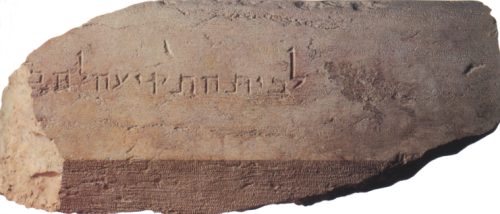
(Image believed to be one of the stones from the Temple! "To the Trumpeting Place" by Talmoryair. Wikipedia. Public Domain in the United States.)
The prophecy of the Temple's destruction was fulfilled only a few decades later, in 70 AD.
This event certainly had significance for the Jews at the time - it was another step, like the veil of the Holy of Holies tearing in two at Christ's death (Matthew 27:51), demonstrating that Judaism was no longer the way to serve God, and that His dwelling place on Earth was no longer a physical building, but in His followers themselves (1 Corinthians 3:16).
But the disciples' questions about the End Times show that they picked up on some apocalyptic significance, as well. This gets into kind of the mind-bending principle that even though we classify the "End Times" as the 7-year Tribulation of Revelation that is yet to come, the "End Times" basically actually started in Acts. For example, the prophecy of the indwelling of the Holy Spirit identified as fulfilled in Acts 2:16-21 is also End Times in nature. But what's significant about the Temple's destruction in terms of the End Times is that it marked a critical event in Roman persecution of the Jews - and of Christians, who were considered a Jewish cult by the Romans. This corresponds with the fact that, throughout history, Christians around the world have been persecuted - something that will intensify more and more as we get closer to the Tribulation.
Brief Elements
How are the false Christs manifested? Well, in 20th century America we have certainly seen some famous cult leaders literally claim to be Christ and amass followings, and I believe we may see a lot more of that as it gets even closer to the Tribulation. But we've also seen people presenting false Christs - such as in the "Christian" cults of Mormonism and the Jehovah's Witnesses, who preach a Jesus and a Gospel totally different than the true ones. And, there have been other religions such as Islam to develop and gain popularity that offer a different identity of God - another type of false Christ.
Next, the passage mentions rampant wars, famines, and earthquakes. There are two ways to look at this: (1) that these will intensify as the world gets closer to the End, and (2) that they will accomplish the "agenda" of the End Times. It seems to me that both have turned out. For example, we've had two world wars in the past century, and major natural disasters certainly seem to be escalating (although I don't have statistics on that). But as for the second way, the End Times are all about demonstrating judgment and bringing people (with emphasis on the Jews) to repentance. We can certainly see how wars and disasters throughout history could be used to accomplish these objectives.
But let's take a moment to step back and look at what Jesus said about how we should react to seeing these things:
We are to not fear. We need to remember that even if the world is consumed by war, if natural disasters shatter our nations, and if people seek to kill us because of our faith, that God is still in control. Easier said than done, obviously, but if we train our minds to remember that God is in control when "little" things go wrong in our lives now, it will be a far more natural reaction when the sky starts to fall.
We are to keep it all in perspective - there are so many "birth pangs" leading up to the "actual" End that we shouldn't freak out that "The End is nigh!" every time a flood happens or some country threatens to nuke the world. That doesn't mean that we shouldn't be psychologically prepared for the possibility of the End Times occurring during our lives, or that we shouldn't actively engage in staying attentive to world events and comparing them with Biblical prophecy, but it does mean we shouldn't go crazy. That only makes people think that Christians are all morons when the End doesn't happen right away - and that can prevent them from coming to Christ themselves.
We need to stay resolute in our faith. More on that directly below.
The Great Apostasy
We Americans are disgustingly unaware of the persecution of our brothers and sisters around the globe, but frankly, outside of the Western World, it's quite rampant. And there are certainly many cases where people renounce their faith because of the persecution. Persecution of Americans has already started on small scales - Christian businesses have been fined for refusing to provide abortion pills to their employees, and we can get fired, suspended from school, and even arrested for "hate speech" for speaking God's Truth. But one day, probably sooner than many people think, global persecution of the Church will arrive - and that includes America. If the authorities showed up at your door today ready to cart you off to prison on the charge of being a Christian - would you proclaim your faith in Him? If the punishment were death - would you still proclaim your faith in Him? We can all flippantly say, "Well, yeah, of course" - that's easy because we don't really think that will happen. But think it through - right now. Vividly imagine that scenario. Picture the handcuffs. Picture the prison. Picture the beatings. Picture the noose, the electric chair, the firing squad.Then ask yourself again: Would you claim Him, or deny Him?
But there's another thing still that drives people to fall away, an evil strong and active in the West right now: apathy. The Church is lukewarm, claiming Christ but not living it out. It accepts fornication, freely uses God's Name in vain, and is lazy, encouraging Christians and "Christians" to pursue their own lives with God on the side, rather than making every education choice, career choice, and relationship choice centered on Him. Because lawlessness is increased, most people's love will grow cold. Evil and apathy are rampant, and the Western Church clings to the abominable lie that we have a "right" to a "normal life" - and that "God understands" this. Friends, that is evil. If a person couldn't look at a random day of your life and tell that you are not just a "Christian" in the American sense of the word, but that you passionately believe it with every fiber of your being, something is wrong.
We cannot stay strong for Christ on auto-pilot - it is a daily war against the flesh, the evils of this world, and Satan's forces. There can be no resting from it until the day we are called home.
The Gospel to All Nations
One of the prerequisites to the literal, official End is for every nation to hear the Gospel. I can't locate exact information at this time, but last I heard, all we have left is a few pockets in Asia and Eurasia. In other words: It's almost fulfilled!
But this brings up another important issue: What about the people who have never heard the Gospel - how is it "fair" that they go to hell when they've never had a chance to get saved? Well, even though God likes to use us to spread His Good News (primarily for our sake, I believe, as it gives us a purpose and helps us mature in our faith), it's not as if He's limited to only using human words to bring people into a saving relationship with Him. Romans 1:20 explains that God reveals the Truth about Himself through nature, and elsewhere Scripture makes clear that if someone is truly seeking God, He will reveal Himself to them, no matter if a missionary is around. In fact, there have been multiple cases in the Middle East where Muslims have sought the True God, and God revealed Himself to them in dreams. There will indeed be people from every tongue and tribe and nation from throughout history in Paradise.
What, then, is the point of the Gospel being verbally preached to all nations before the End can come? I believe it's largely symbolic - that God's purpose for the world has been accomplished completely, at long last.
Any comments you'd like to add - insight, thoughts, further Scripture references?
Or any questions about this passage (or anything about the Bible or Christianity) you'd like to ask?
Then leave a comment below. :-) Or you can e-mail me questions, if you prefer.
Don't know Christ as your Lord and Savior yet? Click here to learn how in English or here to learn how in your own language.
37 "Jerusalem, Jerusalem, who kills the prophets and stones those who are sent to her! How often I wanted to gather your children together, the way a hen gathers her chicks under her wings, and you were unwilling.
38 "Behold, your house is being left to you desolate!
39 "For I say to you, from now on you will not see Me until you say, 'BLESSED IS HE WHO COMES IN THE NAME OF THE LORD!'"
The Timing of These Words
The timing with which Jesus uttered these three short sentences is very significant.
He said them right after an enormous diatribe against the Pharisees (Matthew 21-23), proclaiming their condemnation ... and right before His longest explanation of the coming judgment of the End Times (Matthew 24-25). What's more, He condemned the Pharisees for murdering the prophets (23:34-35), and explained that the same will be committed against Christians during the Tribulation (24:9) - the exact same thing he accuses the residents of Jerusalem of in this passage.
So, far beyond serving only as a segue into talk of the End Times, this passage serves another function: It demonstrates God's incredible love, and His desire for everyone to come to repentance so He does not have to punish them, in the middle of two condemnation passages.
Jerusalem, Who Kills ...
The prophets God sent to the Israelites were for their own sake, to bring the Jews back into God's blessing - and they still killed them. It communicates an incomprehensible amount of love that God would want to forgive them despite that evil sin.
But I'd like to put out there that it goes even deeper than that - that God is yearning for them to come back to Him because of that evil sin. That is, I believe that our sin, and our misery that results from it, makes God so sad that the more sinful you become, the more God wants you to come to Him.
"I tell you that in the same way, there will be more joy in heaven over one sinner who repents than over ninety-nine righteous persons who need no repentance."
- Luke 15:7
Hen and Chicks
Have you ever actually seen a hen gathering a chick under her wings? It totally changes how to read this passage. I couldn't find an image free for the public domain or with a usage release to post here, but I think it's important that you guys see what it actually looks like, so click this link to take you to a results page for a Google Images search for "hen chicks under wing" to see what I mean.
What's important about this is that you see that the chicken is blocking the chicks from harm with her own body. Whatever is trying to eat the chicks will attack her, and she will bear all the suffering and pain. She may die protecting her chicks. Sound like Jesus?
But the Jews refused to accept His love. So, He let their nation have what they wanted - knowing that one day, at the end of the world, they would finally learn from their suffering and see that they need Him.
Desolate
... which brings us to the part about leaving their house desolate.
The "house" referred to is the Temple. God would no longer manifest Himself in the Temple, but would indwell believers instead (Mark 15:37-38, Ezekiel 36:27, Romans 8:11, 1 Corinthians 6:19). On top of that, the Temple would be destroyed by the Romans 40 years later, and has not been rebuilt since.
Like our last study, personal questions will be a significant portion of our exploration of today's passage, but we'll also look at some elements of Jewish culture to deepen our understanding. Also note that today we reach the end of the long interchange between Jesus and the Jewish religious leaders.
Today we cover the passage known as the "Eight Woes," filled with the phrase, "Woe to you..." So before we dive into Scripture, let's define that phrase really quickly.
The word "woe" itself means distress, lamentation, grief, anguish, etc.
So, "woe to you" isn't exactly an act of cursing the "you."
Rather, in this context, the recipients (hypocritical religious elite) will experience that woe because of the implied curse because of their evil acts that Jesus lists out.
13 "But woe to you, scribes and Pharisees, hypocrites, because you shut off the kingdom of heaven from people; for you do not enter in yourselves, nor do you allow those who are entering to go in.
Under the Old Covenant, the Mosaic Law and sacrifices and festivals and all that were the way to serve God, but salvation (because Christ's death reaches both backward and forward in time) was still based on faith, a heart genuinely striving after God (see Romans 4). Since these religious leaders were only interested in bringing glory to themselves, they had no true relationship with God. But the situation was far worse in that these religious leaders were teaching common Jews legalistic principles instead of God's true intent in His Law, preventing them from coming to truly know the Lord for themselves and understand what it meant to really follow Him. False teachers are extremely influential -which is why the Church is instructed to be constantly on watch for them, so no one is sucked in (see 2 Peter 2:1-3 and Romans 16:17-18,for example).
Are you diligent to keep false teachers' words out of your ears and eyes, checking all teachings against the Bible? Do you also try to protect weaker Christians around you from false teaching's influence?
14 ["Woe to you, scribes and Pharisees, hypocrites, because you devour widows' houses, and for a pretense you make long prayers; therefore you will receive greater condemnation.]
We've talked about how to handle bracketed verses before (verses found in some early manuscripts but not others), but if you are new here or need a refresher, click this post and scroll down to the blue sub-header that reads, "What about That Verse in Brackets?" Based on my opinion on the bracketing issue, this verse qualifies as genuine Scripture.
Here, the religious elite were taking advantage of the people they were supposed to be taking care of, and engaging in religious activity just for the sake of appearing holy to others. (For more on the issue of public prayer, look at Matthew 6:1-6.)
But what's the deal with the "greater condemnation"? As I talked about in this post on Matthew 11 (under the sub-heading, "Speaking of the Judgment"), it's not a matter of different circles of hell like in Dante's Inferno; it seems more along the lines of those people having far more shame since they, as God's very own Israel, had far more opportunities to truly know Him than people of other nations had.
15 "Woe to you, scribes and Pharisees, hypocrites, because you travel around on sea and land to make one proselyte; and when he becomes one, you make him twice as much a son of hell as yourselves."
FYI, a proselyte was Gentile convert to Judaism. So basically, these religious elite were going on "mission trips." Obviously, the few Jews who really did love Gentiles enough to go tell them about the One True God were amazing people, but the religious elite referenced here were doing it for all the wrong reasons - for their own glory. That may seem like an odd manifestation of glory-seeking, but a missionary I know has told me that some missionaries have actually gotten saved for real on mission trips (perhaps they went because it's seen as simply a noble thing to do, or a related motivation) - so this still goes on today.
But since most of these scribes and Pharisees never came into genuine relationship with God, they taught the converts the same false teachings they themselves lived by. Think of it kind of like Mormons going on mission trips today.
16 "Woe to you, blind guides, who say, 'Whoever swears by the temple, that is nothing; but whoever swears by the gold of the temple is obligated.' 17 "You fools and blind men! Which is more important, the gold or the temple that sanctified the gold? 18 "And, 'Whoever swears by the altar, that is nothing, but whoever swears by the offering on it, he is obligated.' 19 "You blind men, which is more important, the offering, or the altar that sanctifies the offering? 20 "Therefore, whoever swears by the altar, swears both by the altar and by everything on it. 21 "And whoever swears by the temple, swears both by the temple and by Him who dwells within it. 22 "And whoever swears by heaven, swears both by the throne of God and by Him who sits upon it.
There are a lot of little details here that may seem confusing, but the basic principle is actually quite simple:
In Jewish culture, people often swore to do certain things in the service of God - like abstain from something for a set time, or give Him a certain percentage of their income.
In the Old Testament, keeping your vows is treated as extremely serious (Deuteronomy 23:21-23, for example).
But the religious elite decided to make up all sorts of little "word game" rules to let people get out of their vows.
Obviously, this was an affront to God.
Have there been times when you've known that God wanted you to do something, but you tried to justify your way out of it?
23 "Woe to you, scribes and Pharisees, hypocrites! For you tithe mint and dill and cumin, and have neglected the weightier provisions of the law: justice and mercy and faithfulness; but these are the things you should have done without neglecting the others. 24 "You blind guides, who strain out a gnat and swallow a camel!
The religious leaders were also big on counting tiny seeds and flecks of herbs to tithe the set percentage - because such time-consuming acts were seen as very religious. But they totally ignored the big-picture commands like loving others, which cannot be quantified and are not as noticed - and are actually much harder to do, when you really think about it.
Modern examples include spending (say) 2 hours in prayer and Bible study each day - but that clutters your schedule so much that you don't have time to show God's love to your elderly neighbor by helping her with yard-work. Or having rigid rules of exactly how many inches below your collarbone or above your knee the clothes you buy can go - but not dealing with your pride or judgmentalism.
Does this principle "click" with your life in any way?
25 "Woe to you, scribes and Pharisees, hypocrites! For you clean the outside of the cup and of the dish, but inside they are full of robbery and self-indulgence. 26 "You blind Pharisee, first clean the inside of the cup and of the dish, so that the outside of it may become clean also. 27 "Woe to you, scribes and Pharisees, hypocrites! For you are like white-washed tombs which on the outside appear beautiful, but inside they are full of dead men's bones and all uncleanness. 28 "So you, too, outwardly appear righteous to men, but inwardly you are full of hypocrisy and lawlessness.
Jesus Himself interprets His symbols and sums it all up in verse 28, so I won't spend much time here, except to prompt:
Are there things you do to look religious when other people are watching, but that are the exact opposite of what you truly are like on the inside? (For example, putting lots of money in the offering plate, but refusing to lend a family member money so they can make their rent.)
29 "Woe to you, scribes and Pharisees, hypocrites! For you build the tombs of the prophets and adorn the monuments of the righteous, 30 and say, 'If we had been living in the days of our fathers, we would not have been partners with them in shedding the blood of the prophets.' 31 "So you testify against yourselves, that you are sons of those who murdered the prophets. 32 "Fill up, then, the measure of the guilt of your fathers. 33 "You serpents, you brood of vipers, how will you escape the sentence of hell? 34 "Therefore, behold, I am sending you prophets and wise men and scribes; some of them you will kill and crucify, and some of them you will scourge in synagogues, and persecute from city to city, 35 so that upon you may fall the guilt of all righteous blood shed on earth, from the blood of righteous Abel to the blood of Zechariah, the son of Berechiah, whom you murdered between the temple and the altar. 36 "Truly I say to you, all these things will come upon this generation."
Wow, there's a lot of information in this passage! I think I'll focus on two main points:
First: While there are many, many ways God uses the persecution of His saints for His glory (you can check out the "Persecution" tab under "Studies by Topic" on the left, if you're interested in studying this out deeper), in this passage, the focus seems to be to give the persecutors even more chances to repent through the testimony of the martyrs, and to heap more shame on them when they reject it (as we discussed above). God doesn't waste the suffering and death of His martyrs - He offers mercy to the persecutors, but if they refuse to accept it, His justice will prevail for the martyrs (see Revelation 6:9-11).
Second: We as humans always talk big, claiming we would have acted nobly during some time period where radical social change led to conflict. But a major point I see in this passage is that, while we may think times have changed and we're not faced with that same decision today, we really are facing the same choices - so if we say we would have acted a certain way, why aren't we???
"If I were alive during the Holocaust, I would have done whatever I could to help save the Jews!" Unborn babies created by God are being slaughtered everyday - are you standing up to help save them?
"If I lived around the time of the Civil War, I would have helped free the slaves!" Slavery still exists in the world today - what are you doing to put a stop to that?
"If I lived during the Protestant Reformation, I would have been willing to die for my faith!" (Not picking on Catholics here; I've just heard this line a lot.) Well, today, right here and now, are you willing to bear shame and be socially ostracized, and risk your job and your grades and your family for your faith?
"If I lived in Jesus's day, I would not have been ashamed to minister to the outcasts and sinners right alongside Him!" Today, are you showing God's love to homosexuals, and the homeless, and people who annoy you, and people seen as "weird" - not worrying what people will think of you for spending time with them?
I say these just as much as a challenge to myself as to you guys. We need to take it seriously. We need to actually do what Jesus would do, instead of throwing around the cliché acronym without putting any thought into how to put it into practice.
Image credit: "The Sermon of the Beatitudes" by James Tissot. Wikipedia. Public domain in the United States.
Today's passage isn't really considered deep from a study perspective - there are minimal analogies and Biblical history involved, nothing that demands digging into original languages, and no prophetic elements. However, from the viewpoint of personal application, there is an abundance of critical information here. I mean, think about it - if the God of the universe says something is important enough to go in His Book, we should pay attention, right? ;-) Anyway, because of the nature of this passage, I recommend that you read this post at a time when you're not rushed so that you can reflect on your own heart along the way. I prompt these private reflections in green lettering.
Let's dive in! :-)
1 Then Jesus spoke to the crowds and to His disciples,
2 saying: "The scribes and the Pharisees have seated themselves in the chair of Moses;
3 therefore all that they tell you, do and observe, but do not do according to their deeds; for they say things and do not do them.
"Seating themselves in the chair of Moses" is a way of saying that these religious leaders were trying to get others to recognize them with the ultimate status, prestige, and authority. To put this in modern terms, it's someone putting himself in the chair of the Pope or Billy Graham.
In what ways do you seek to be above any others, whether that be in status/prestige or in authority over them?
These religious leaders were also hypocrites, demanding that others obey enormous sets of rules that they themselves couldn't even follow.
Are there things you judge other people for doing, yet also struggle with yourself? Or, is your issue comparing sins - thinking that what you do wrong is "less bad" than what others do?
In this case, Jesus told the listeners to follow the teachings of the religious leaders, I think likely because of the reasons Paul referenced in 1 Corinthians 8, limiting the freedom in Christ you know you are entitled to so you don't offend others. (There may be other reasons in this specific case, as well.) But motivation is key here - we don't want to become just like the Pharisees in the process! So, we should constantly keep humility at the forefront of our minds.
Are there situations where you've gone along with something you considered legalistic or unnecessarily restrictive to avoid offending people, then began to get comfortable with it and expect others to live the same way? (I'm not talking about things that really were wrong to begin with and you came to learn that.)
4 "They tie up heavy burdens and lay them on men's shoulders, but they themselves are unwilling to move them with so much as a finger.
We've already talked about the hypocritical legalism aspect of this, but another application to modern life I've seen has to do with effort. I've seen situations where some people look like they're really involved in a ministry or project, but really just be organizing and delegating. Now, sometimes, this can be a genuine manifestation of the gift of administration, but other times, it can be a very, very bad thing where someone wants all the credit for doing little of the work.
Does what I've said above strike a chord with any aspect of your life?
5 "But they do all their deeds to be noticed by men; for they broaden their phylacteries and lengthen the tassels of their garments.
Phylacteries and tassels were both accessories to religious garb in Ancient Israel (they're still used by some Jewish sects). So, big phylacteries and long tassels both said "Look how religious I am!" in two ways: They were more cumbersome, making the wearer look more sacrificial, and their size simply drew the eye.
Although the specifics have changed, this problem still runs rampant in the Church today. Sometimes a person who doesn't normally wear a cross necklace for themselves will suddenly wear one just to look extra religious for others. Or someone who rarely prays to God on their own will be asked to pray over a meal on a religious holiday and go over-the-top with something more like a KJV-stylized speech than a conversation with God. Of course, there are many, many more manifestations of this.
Matthew 6:1-6 has much to say about this topic, as well.
What aspects that you associate with your faith would you not do if no one else was around and it was just you and God?
6 "They love the place of honor at banquets and the chief seats in the synagogues,
7 and respectful greetings in the market places, and being called Rabbi by men.
8 "But do not be called Rabbi; for One is your Teacher, and you are all brothers.
9 "Do not call anyone on earth your father; for One is your Father, He who is in heaven."
Once again, this is far too applicable to the modern Church! I cringe when I hear a religious leader insist on being called "Reverend so-and-so" or "Pastor so-and-so" or "Dr. so-and-so." Someone in this person's congregation choosing to call them "Pastor so-and-so" doesn't normally strike me as an issue, since it's naming their spiritual gift and the leader himself did not request to be called that - but in virtually any other situation, I see it as flying in the face of these verses.
Even calling a pastor "Pastor so-and-so" doesn't sit totally okay with me if it's prevalent in a congregation, but for another reason: the clergy-laity divide. Basically, I don't like anything that separates the "official" clergy/ministry team/whatever you want to call it from what is considered the congregation. We all have spiritual gifts, and are all intended to use them at church gatherings, so the concept of official clergy is highly unbiblical (see my extensive exploration of spiritual gifts here) (verses 8-9 get at the fact that all believers are equal, as well). So, if we call someone with the gift of pastoring "Pastor so-and-so," should we call someone with the gift of celibacy "Celibate so-and-so" or the gift of poverty "Willingly-Poor so-and-so" or the gift of tongues "Tongues-er so-and-so"??? But anyway... :-) This paragraph is more my views that I base on the Bible, and is not something I'm claiming to be taught directly in Scripture.
If you're involved in some sort of ministry, do you make a point to mention that as part of your identity when meeting people, or love it when other people bring that up?
(One little side-note about verse 9: That's not saying you can't call your dad "Dad," or even that you can't consider the person you brought you to Christ your "father/mother in the faith" - Paul calls Timothy his son, for example. But what this is getting at is elevating some religious leader to an overly high status, so that it becomes a form of idolatry.)
11 "But the greatest among you shall be your servant.
12 "Whoever exalts himself shall be humbled; and whoever humbles himself shall be exalted.
These final verses are a message we have heard over and over and over and over in Matthew. That repetition reveals that it's a major issue! And the many times we've encountered it through Matthew in multiple different contexts, and have seen multiple modern parallels to those contexts, further demonstrates how critical it is to constantly keep this in mind.
Image credit: "The Synagogue in Florence, Italy" by Toksave. Wikipedia. Used by permission.
41 Now while the Pharisees were gathered together, Jesus asked them a question:
42 "What do you think about the Christ, whose son is He?" They said to Him, "The son of David."
43 He said to them, "Then how does David in the Spirit call Him 'Lord,' saying,
44 'THE LORD SAID TO MY LORD, "SIT AT MY RIGHT HAND, UNTIL I PUT YOUR ENEMIES BENEATH YOUR FEET"'?
45 "If David then calls Him 'Lord,' how is He his son?"
46 No one was able to answer Him a word, nor did anyone dare from that day on to ask Him another question.
God of Power
We've heard the Pharisees test Jesus time and time again - and every time, He has completely baffled them with His incredible wisdom. But now, He puts a stop to their arrogant questions, posing a riddle of His own to befuddle them and then proceeding with a long list of accusations and curses against them. I adore this display of our God's incredible power! With one simple question, he astounds the listeners so much that "nor did anyone dare from that day on to ask Him another question"! Studying through Matthew, we have seen so much of Jesus's "Suffering Servant" side, that the few pre-End Times glimpses we get of Him as the Mighty Conqueror are a wonderful variation. :-)
So what was Christ's objective with this question? Well, shutting the Pharisees up, obviously, but specifically: To turn their own tactic against them by demonstrating that they were the ones who didn't understand the Law - they couldn't even explain a simple seeming-contradiction!
Whoever exalts himself will be humbled...
- Matthew 23:12a
The proud look of man will be abased And the loftiness of man will be humbled, And the Lord alone will be exalted in that day.
- Isaiah 2:11
Pour out the overflowings of your anger, And look on everyone who is proud, and make him low. Look on everyone who is proud, and humble him, And tread down the wicked where they stand.
- Job 40:11-12
So let's look at the Old Testament passages that Jesus and the Pharisees are discussing:
The Christ's (aka Messiah's) status as a son of David is written all over the Old Testament. For example, Jeremiah 23:5-6 reads, "Behold, the days are coming," declares the Lord, "When I will raise up for David a righteous Branch; And He will reign as king and act wisely And do justice and righteousness in the land. In His days Judah will be saved, And Israel will dwell securely; And this is His name by which He will be called, 'The Lord our righteousness.'" Other good examples you might want to check out are Isaiah 11, Isaiah 9:6-7, and Ezekiel 34:23-24.
The verse Jesus references in verse 44 of today's passage is Psalm 110:1, and if you read that entire Psalm (only 7 verses - read it!), you'll see how undeniably Messianic it is.
The quandary facing the Pharisees, then, is how the same "person" could be both David's son and his Lord. Because of the many revelations Jesus has given to Christians, we know that:
Jesus can be David's son because when He took on human form to die for us, that body was physically descended from King David (Matthew 1, Luke 3:23-38).
But, at the same time, Jesus is King David's spiritual ancestor, because He is the Creator of all things - God Himself!
23 On that day some Sadducees (who say there is no resurrection) came to Jesus and questioned Him,
24 asking, "Teacher, Moses said, 'IF A MAN DIES HAVING NO CHILDREN, HIS BROTHER AS NEXT OF KIN SHALL MARRY HIS WIFE, AND RAISE UP CHILDREN FOR HIS BROTHER.'
25 "Now there were seven brothers with us; and the first married and died, and having no children left his wife to his brother;
16 so also the second, and the third, down to the seventh.
27 "Last of all, the woman died.
28 "In the resurrection, therefore, whose wife of the seven will she be? For they all had married her."
29 But Jesus answered and said to them, "You are mistaken, not understanding the Scriptures nor the power of God.
30 "For in the resurrection they neither marry nor are given in marriage, but are like angels in heaven.
31 "But regarding the resurrection of the dead, have you not read what was spoken to you by God:
32 'I AM THE GOD OF ABRAHAM, AND THE GOD OF ISAAC, AND THE GOD OF JACOB'? He is not the God of the dead but of the living."
33 When the crowds heard this, they were astonished at His teaching.
The Sadducees Join In
The Sadducees' question to Jesus was presented in a different way than the Pharisees challenged Him: Rather than trying to trap Him into angering some group or another with a controversial answer, they wanted to completely baffle Him - thereby not only demonstrating Him to be a fool (thus eliminating the "Jesus problem" that plagued all the Jewish religious elite), but also providing a significant victory for their side of the doctrinal argument they waged with the Pharisees by showing that belief in a resurrection is illogical. It was a chance to take out two types of enemies at once. But, once again, Jesus simply could be defeated.
Now, to us, the aspect of the Mosaic Law where a man was to marry his late brother's wife so their first child would count as his brother's descendant is not exactly commonplace. But in terms of the Sadducees' challenge, it's no different that a situation we see as normal: A widow or widower marrying again after the death of the original spouse. With the "weirdness" of marrying your brother's wife out of the way, it's easy to see why this scenario was an applicable objection to the concept of life after death.
But Jesus explained that after we die, we become like the angels. Note the word like - we do not become angels when we die, no matter what the media and art portray. Angels are separate created beings with distinctive appearances (see Ezekiel 1:1-28 and 10:20, and Isaiah 6:1-8), whereas our eternal, glorified bodies will be like Christ's (1 John 3:2); additionally, 1 Peter 1:10-12 reveals that God distinguishes between humans and angels in that he allows us to understand salvation on a deeper level (so, becoming an angel would be regressing). However, we will be like angels in the sense that we will be outside of a social construct involving marriage and romance. Our relationships with each other will change in eternity.
Jesus expanded into defending the very principle of life after death, not just refuting their example. You see, God proclaimed Himself to be the God in the present tense of those 3 patriarchs long after they were all dead in Exodus 3 when He's speaking to Moses through the burning bush. He did not say, "I WAS the God of..." He said "I AM the God of..." Since "I AM" is an extremely common name of God used in the Old Testament (it's translated "Lord," so we don't see it spelled out a lot), Jesus used something that even the most uneducated Jew would have been familiar with to refute the Sadducees' lofty theological stance with one blow.
Some people claim that life after death was a new concept introduced in the New Testament, but this simply is not true. For example, the Pharisees believed in a spiritual resurrection of the dead - that's why they fought with the Sadducees! Here are just a couple of Old Testament examples pointing to life after death:
Psalm 23:6 "Surely goodness and lovingkindness will follow me all the days of my life, And I will dwell in the house of the Lord forever."
Genesis 37:35: "... Surely I will go down to Sheol in mourning for my son..."
Would you like eternal life? Click here to learn how to have it in English, or click here to learn in a different language.
Scripture #2
34 But when the Pharisees heard that Jesus had silenced the Sadducees, they gathered themselves together.
35 One of them, a lawyer, asked Him a question, testing Him,
36 "Teacher, which is the greatest commandment in the Law?"
37 And He said to him, "'YOU SHALL LOVE THE LORD YOUR GOD WITH ALL YOUR HEART, AND WITH ALL YOUR SOUL, AND WITH ALL YOUR MIND.'
38 "This is the great and foremost commandment.
39 "The second is like it, 'YOU SHALL LOVE YOUR NEIGHBOR AS YOURSELF.'
40 "On these two commandments depend the whole Law and the Prophets."
Last Ditch Effort
At least in Matthew's account, this is the last question the religious elite try to baffle Christ with. This question wasn't one with a yes-or-no answer that would alienate some people either way; it was a very open-ended challenge that could mean it opened many people up to offense...or it could mean an epic fail for the Pharisees if Jesus's answer was wise. The outcome, of course, was the latter.
Although it seems like an incredibly simple answer to us who have heard it dozens if not hundreds (if not thousands!) of times, the fact that literally every single command and every single prophetic message can be boiled down to Loving God and Loving Our Neighbors (which is, in itself, a mere manifestation of Loving God) is critical to our theology. Here I share two particularly major ways it does:
We Christians believe that we are under the "New Covenant," meaning we don't have a long list of rules to keep, but rather, as a response to God's grace, try to live our lives in a way that pleases Him (Hebrews 9:15, Romans 6). Since God never changes and His Law is eternally holy (Hebrews 13:8, Matthew 5:17-18), the Old and New Covenants have to "mesh" somehow - and they do by the fact that Old Testament rules demonstrated an itemized way to live out the New Covenant principle during a specific time period God chose.
We also believe that even those who have never heard the Gospel have the opportunity to recognize in their hearts that they are imperfect and cannot become perfect people on their own (Romans 1:20, Revelation 5:9 and 7:9). In order for them to be able to try to follow God's standards (just as we do), it has to be able to be boiled down to such simple principles that anyone could think of, not seemingly-random manifestations given only to the Jews like don't eat lobster.
So, how can we live out:
Loving God with all our heart?
Loving God with all our soul?
Loving God with all our mind?
Loving our neighbors as ourselves?
Let's each mull over those questions today, and if you come up with an idea worth sharing, leave a comment. :-) Or if you have something else to add to our discussion, feel free to speak up!
Image Credit: "The queen bee in a hive" by Bienenkoenigin_43a.jpg and B kimmel. Wikipedia. Used by permission.
Today we continue a long stretch in Matthew that features a verbal showdown between Jesus and the Jewish religious elite.
The Scripture
15 Then the Pharisees went and plotted together on how they might trap Him in what He said.
16 And they sent their disciples to Him, along with the Herodians, saying, "Teacher, we know that You are truthful and teach the way of God in truth, and defer to no one; for You are not partial to any.
17 "Tell us then, what do You think? Is it lawful to give a poll-tax to Caesar, or not?"
18 But Jesus perceived their malice, and said, "Why are you testing Me, you hypocrites?
19 "Show Me the coin used for the poll-tax." And they brought Him a denarius.
20 "And He said to them, "Whose likeness and inscription is this?"
21 They said to Him, "Caesar's." Then He said to them, "Then render to Caesar the things that are Caesar's; and to God the things that are God's."
22 And hearing this, they were amazed, and leaving Him, they went away.
The Question
The religious elite had been trying to trap Jesus for a long time by getting Him to answer difficult questions, convinced that no matter how He answered, He was sure to alienate one group or another (it just never worked out for them). But this time, they upped the ante: They brought in the Herodians.
The Herodians were Jews who totally went along with Roman oppression - they betrayed their people and made friends with Roman politicians. Before, they had put Jesus in situations where an answer could make Him lose favor with certain groups of Jews. But here, an answer could make Him either lose favor with all true Jews - or be turned in for treason by the Herodians and be executed. Either way, the religious elite would win on a massive scale.
Except that our God is infinitely wise, and cannot be trapped by human schemes.
I find it very interesting that Jesus continually answered the religious elite through their many tests. Let's glance at 1 Chronicles 16:24 for a moment, an idea that pops up time and time again in the Old Testament:
Tell of His glory among the nations, His wonderful deeds among all the peoples.
Our God doesn't need validation - His self-confidence is not in a state of loss when people don't recognize His glory. Rather, Old Testament instruction like this is primarily for the sake of those nations - because God loves those people, and eagerly desires them to come to repentance and faith in Him.
In the exact same way, in today's passage, it's not like Jesus felt some drive to answer the religious elite to convince them or show off to them (His revelation of His glory to the unbelievers will occur at the very end of time). Rather, I see His continued answers as for the sake of the crowd - displaying His incomprehensible wisdom as a way to demonstrate His deity to them, to give them evidence that He is indeed Messiah.
In addition, His answer explains an important lesson ...
The Answer
If you're familiar with the Bible but haven't really examined this passage before, then 1 Corinthians 10:26 (or Psalm 24:1, which it quotes) may have popped into your head as an objection:
For the earth is the Lord's, and all it contains.
The problem with that reasoning is that the coin didn't stop being God's when a Jew gave it to Caesar - because everything that Caesar owned was God's. ;-) But actually, this is completely unrelated to the point I see Jesus making.
We arrive at an enormous paradox that every Christian must work out in their own lives: Every single aspect of our lives should be centered around Christ and eternity, and yet, we live under a covenant of freedom in which we don't have to worry about legalism and rules inhibiting our functioning. In this case, going along with an occupying force's demand for taxes was not a sin - it was suffering, a suffering that would have been made worse by refusing to comply.
Now, that can't be applied across the board. For example, we can't deny Christ even when our lives are at risk (see Matthew 10:32-33). For me, it kind of makes sense that there's a distinction between my stuff (because it's just that - stuff) and myself. But we are not provided with a list of rules about what we can do and cannot do in situations like these. The key is to continually strive after God. If we "practice" seeking, discerning, and following God's will now, in the little things, then we'll have the answers we need for the big things when they present themselves.
As Bible teacher Ron Daniel points out, the denarius was made in Caesar's image, but we are made in God's image (Genesis 1:27); therefore, what God wants us to give to Him is ourselves. Sometimes this can indeed include our stuff (see Acts 2:44-45), but not in a legalistic sense.
Does this all seem a bit theoretical, hard to put into practice? Let's think about a situation we had here in America just a few years ago: There was an uproar over mandatory American tax dollars funding abortions. Is that deplorable? Absolutely - it is not possible to state how much so. But that evil is not our doing, just as the atrocities committed by the Roman Empire were not the doing of the Jews who paid taxes. It's the exact same. The Romans would have seized their money and thrown the Jews in jail if they had not paid, so it would have made no difference. Taxation is a very different situation from, say, German Christians who hid Jews in their homes during the Holocaust - because that did make a difference.
Again, don't read any of this as absolutes - situations like this are complex, so the only way to get an "answer" for what to do in a given situation is to actively seek God's will.
So, what can we do as we're trapped in a world so evil? Live our lives for Christ every minute of every day. Because Christ wants us.
[S]o that you will prove yourselves to be blameless and innocent, children of God above reproach in the midst of a crooked and perverse generation, among who you appear as lights in the world, holding fast to the word of life. - Philippians 3:15-16a
How do you wrestle with making sense of paradoxical situations like this?
New Post Schedule (since life is settling into a routine again): Definitely one each weekend, and usually one each mid-week, as well.




.jpg)


.jpg)
