Showing posts with label Materialism. Show all posts

Monday, March 18, 2013

Eternal Life How-to: Matthew 19:16-26

The Scripture
 
16 And someone came to Him and said, "Teacher, what good thing shall I do that I may obtain eternal life?"
 
17 And He said to him, "Why are you asking Me about what is good?  There is only One who is good; but if you wish to enter into eternal life, keep the commandments."
 
18 Then he said to Him, "Which ones?"  And Jesus said, "YOU SHALL NOT COMMIT MURDER; YOU SHALL NOT COMMIT ADULTERY; YOU SHALL NOT STEAL; YOU SHALL NOT BEAR FALSE WITNESS;
 
19 HONOR YOUR FATHER AND MOTHER, and YOU SHALL LOVE YOUR NEIGHBOR AS YOURSELF."
 
20 The young man said to Him, "All these things I have kept; what am I still lacking?"
 
21 Jesus said to him, "If you wish to be complete, go and sell your possessions and give to the poor, and you will have treasure in heaven; and come, follow Me."
 
22 But when the young man heard this statement, he went away grieving; for he was one who owned much property.
 
23 And Jesus said to His disciples, "Truly I say to you, it is hard for a rich man to enter the kingdom of heaven.
 
24 "Again I say to you, it is easier for a camel to go through the eye of a needle, than for a rich man to enter the kingdom of God."
 
25 When the disciples heard this, they were very astonished and said, "Then who can be saved?"
 
26 And looking at them Jesus said to them, "With people this is impossible, but with God all things are possible."
 
Brief Notes on the Approach to This Study
 
I know that for people who have been Christians for a while, they've heard this story over and over.  But stick around - I hope we'll all walk away with some new nuggets from this important story. :-)
 
Also, sometimes I approach a passage topically, with neatly organized notes separated out based on what's related to what.  For this passage, it's framing itself out chronologically in my mind, so that's what you'll find below. :-)
 
What Good Thing Shall I Do...

 
From our perspective where we know that eternal life is the result of accepting Christ's forgiveness, not earning it through good works, this man approaches Jesus with the absolute wrongest question.  But - he is indeed seeking the Truth...and Jesus answers him.  This tells me two things about our God: (1) God wants humans to come to know Him so much - no matter how far away a person is from Him, if that person seeks the Truth even the slightest bit, God will reveal Himself to him/her.  (2) We can apply this after we are saved, as well: We can come to Christ any time with any question about His will or His truth and ask Him to reveal the answer to us, and if we pay attention to the various ways He speaks to us (Bible verses/passages, life circumstances, spiritual insight/"words" from mature beleivers, "speaking" to us in our hearts, etc.), we will find that He is answering.
 
The first part of verse 17 has been taken ways.  We know from the rest of the Bible that Jesus is God, so in saying that only God is good here, He is not denying being God (see this fantastic list of Bible verses declaring Jesus to be God).  So, what's Jesus saying here?  I interpret it as Him saying it sort of tongue-in-cheek.  He is pointing out what the man is either unwilling to admit verbally or perhaps even to himself - that he truly believes that the "Teacher" he questions is God, the Messiah.
 
Now, Jesus's answer, at face value, appears as if He's telling the man that he really can achieve eternal life by living a perfect life - but we know that to be impossible.  Note also that this is not an exhaustive list of all that's required - He's giving examles representative of the Mosaic Law.  But the point of this list is get to the final item, "love your neighbor as yourself," which sticks out like a sore thumb because it's the only one on that list that's not part of the ten commandments, one of the two most important ones (because loving God and loving others have to do with motives, not rules), and, most importantly for our discussion, it was the commandment this man had failed at!
 
I highly doubt that this man really had managed to keep the commandments - I think he was probably pretty self-disillusioned.  But, regardless, Jesus focuses on his biggest problem: He was selfish, treating money like an idol and neglecting the poor.  But there are two points to this story - the first is salvation through grace alone, and the second is not that we need to donate our stuff to charity.  The point is that we all have that one thing that battles with Christ for holding first place in our lives.  For you or me, it may be popularity, reputation, a sense of control over your life, a particular relationship, a pasttime, a lifestyle, whatever.  But if Christ is truly our Lord, we need to be willing to give that up for Him and obey His simple call to "Follow Me!"
 
At the same time, however, I think money is quite a common idol for many people, especially in America, so I don't want to gloss over the seriousness of that facet.  I'd like to challenge us all to take a deeper look at how much we value money in our lives.  What do we spend it on?  Do we spend any on what God asks of us?  How much time do we spend obtaining more money?  How much time do we spend serving and getting to know God?  How much time do we spend longing for more money?  How much time do we spend thinking about God?  What do these answers reveal about how our love of money compares to our love of God?
 
Finally, Jesus's brief analogy about the camel tells us two things.  First, it is a reiterration that it is God's forgiveness, not our good works, that grant us salvation from our sins.  Second, it demonstrates that God can forgive absolutely any sin - no person, no matter what they have done, is beyond God's grace.
 
If you haven't accepted God's forgiveness and would like to, click here to find out how in English or here in your own language.
 
Questions for You
 
What have you asked God to reveal to you?  What did He reveal?
 
What "one thing" that competes with Christ for lordship in your life causes you the most difficulty?  How has God helped you in making progress to conquer it?
 
Image Citations
 
Number One: Chinese depiction of Jesus and the rich man.  Wikipedia, uploaded by Ai.kefu.  {{PD-ART}} Public domain in source country and the United States.
 
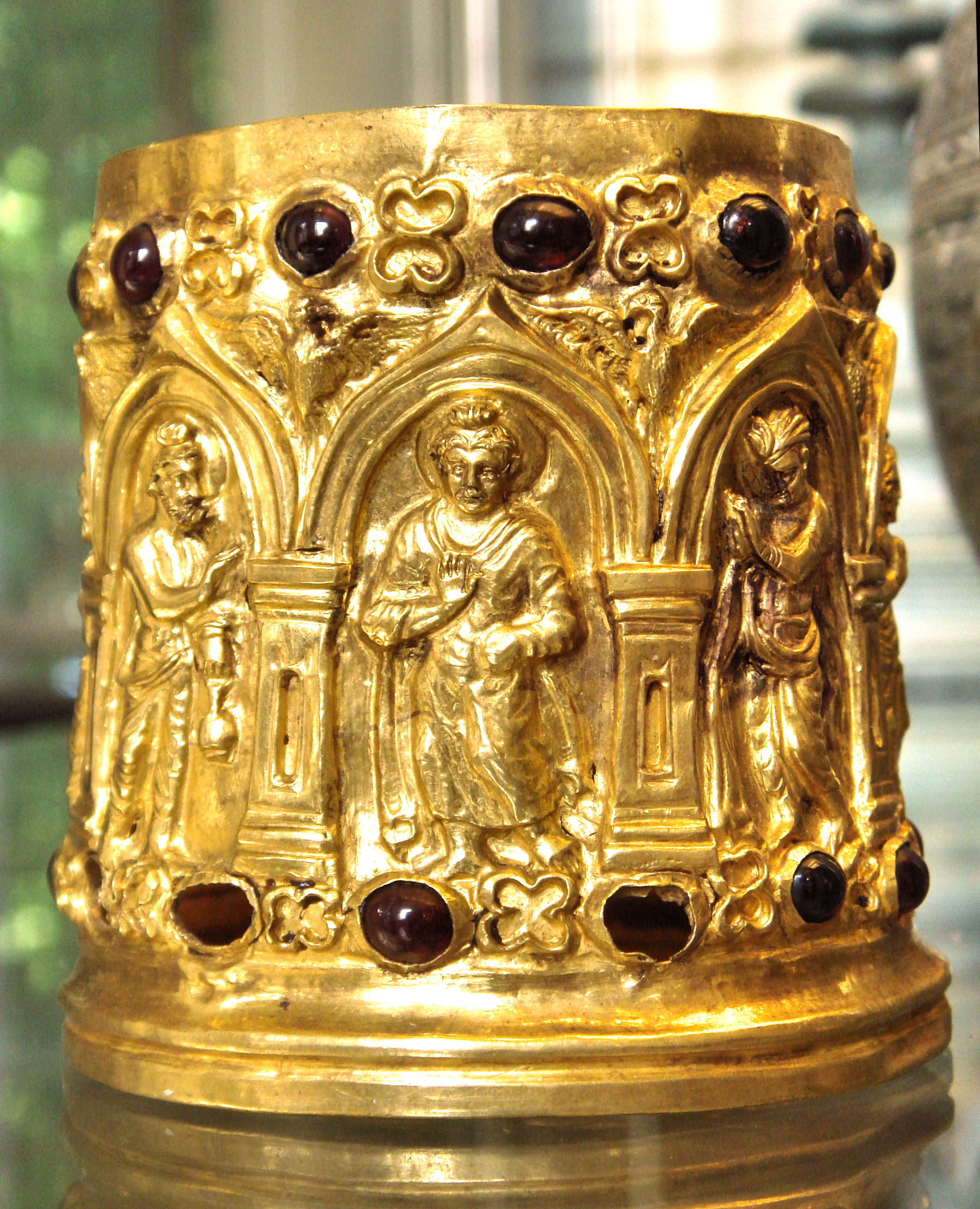
Number Two: Bimarin Casket.  Wikipedia, used by permission.


Sunday, July 8, 2012

Putting It All Into Perspective - Matthew 6:19-34

Money, Money, Money

19 "Do not store up for yourselves treasures on earth, where moth and rust destroy, and where thieves break in and steal.

20 "But store up for yourselves treasures in heaven, where neither moth nor rust destroys, and where thieves do not break in and steal.

21 for where your treasure is, there your heart will be also.

22 "The eye is the lamp of the body; so then if your eye is clear, your whole body will be full of light.

23 "But if your eye is bad, your whole body will be full of darkness.  If then the light that is in you is darkness, how great is the darkness!

24 "No one can serve two masters; for either he will hate the one and love the other, or he will be devoted to one and despise the other.  You cannot serve God and wealth."

I see this passage making two arguements against the pursuit of riches: it's pointless, and it's evil.

Let's look at pointlessness first.  Think of all the things that can happen to wealth: your stocks can crash, a natural disaster can wipe out phsyical property and overrun insurance can't cover it, a thief can steal it (physically or electronically), the ecomony can crash and your money will be worthless.  Or, you could just die, and then it's completely worthless to you.  With all the time and energy devoted to wealth, how is it worth it?  Talk about a wasted life!

The other side is that the pursuit of wealth is idolatry, because money will take God's place in your life.  How?  A few ways: your TIME (time spent working overtime, researching stocks, etc. that you could spend studying the Bible, praying, or in ministry), your FOCUS (every extra second spent thinking about money is one less second spent thinking about God and how to show His love to others), and your PERSPECTIVE (by always thinking about money, you'll start to think in terms of the physical world and forget that this is just one tiny portion of eternity).

Now, what's this whole "eye is the lamp of the body" talk?  To be honest, this verse has baffled me for years, but I think I'm *finally* starting to figure it out...maybe. :-)  Here's what I *think* it means...  Back in the time when this was written, after the sun set, you had to carry a lamp around with you to see things.  So, whatever you shined its light on was what you saw - and only that.  So, if your eyes (literal and spiritual) are focused on the things of this world, that's going to permeate your whole life, but if you're focused on the things of God, He is going to permeate your whole life.  Moreoever, if your lamp is somehow bad (like if the sides are dirty and clouded or cracked), you're going to get a skewed picture of reality.  Likewise, looking at the world through bad eyes (eyes focused on the non-eternal) is going to give you a skewed picture of reality.

Now, while we're on the subject of wealth, I want to talk a bit about our culture of consumerism.  I know from personal experience how hard it is not to get sucked in - trust me, I struggle with it every single day of my life!  We are surrounded by a million messages telling us that it's normal to want more, that we need more, that it's our right to have more.  Clothes, entertainment, expensive coffee drinks, the newest iWhatever...we waste SO much money on things that don't matter!  People have lived in huts with just the clothes on their back, eating the cheapest food they can find, for thousands of years...how dare we insinuate that we *have* to have more just to live a "normal human life"?  I am here and now making a commitment to seriously rethink my budget and commit more of it to eternal things.  Will you join me?

One more rant before we move on to the next passage of Scripture. :-)  There are some denominations, authors, and speakers out there who claim that God wants you to be rich, that being rich is evidence that you are a good Christian, and pray for money more often than anything else.  This is a completely anti-Biblical, despicable, and sinful teaching.  God sometimes blessed His followers with wealth in the Old Testament as a way of drawing unbelievers to Him, but now that we are under the new covenant, He has the same goal, but is approach is radically different.  Aside from today's passage, also consider Matthew 19:24 and James 1:9-11, or check our studies on "Materialism" and "Wealth" under the "Studies by Topic" section to the lower right.

No Need to Worry

25 "For this reason I say to you, do not be worried about your life, as to what you will eat or what you will drink; nor for your body, as to what you will put on.  Is not life more than food, and the body more than clothing?

26 "Look at the birds of the air, that they do not sow, nor reap nor gather into barns, and yet your heavenly Father feeds them.  Are you not worth much more than they?

27 "And who of you by being worried can add a single hour to his life?

28 "And why are you worried about clothing? Observe how the lilies of the field grow; they do not toil nor do they spin,

29 yet I say to you that not even Solomon in all his glory clothed himself like one of these.

30 "But if God so clothes the grass of the field, which is alive today and tomorrow is thrown into the furnace, will He not much more clothe you?  You of little faith!

31 "Do not worry then, saying 'What will we eat?' or 'What will we drink?' or 'What will we wear for clothing?'

32 "For the Gentiles eagerly seek all these things; for your heavenly Father knows that you need all these things.

33 "But seek first His kingdom and His righteousness, and all these things will be added to you.

34 "So do not worry about tomorrow; for tomorrow will care for itself.  Each day has enough trouble of its own."

I love this *beautiful* passage.  It's a love letter from God to us, saying, "You don't have to worry - I will personally take care of you."  We can rest assured that even when something catastrophic happens - losing your job, your house catching fire - it's not like God has forgotten about you or is angry at you.  It's just that He's got a bigger plan you can't see all of right now.  He's still taking care of you.

Some may say that it's a nice enough passage, but is an empty promise that doesn't play out in real life.  I beg to differ!  Sometimes God uses supernatural means - for example, I know a poor family that went through a particularly rough time whose cabinets "somehow" never became empty until the next paycheck arrived.  Other times, God prompts other people to take care of you - for example, a family from my church had an enormous personal crisis and it was shocking how many people they didn't even know came out of the woodwork to offer them support and aid.

However, this is not an excuse to be lazy, loaf around the house all day, and just *expect* God to take care of you.  Check out what Paul has to say about that in 2 Thessalonians 3:10-12!  We are to know that God does take care of us, but not demand that he arrange everything for us so we never have to work a day in our life!

Finally, let's go over verses 33-34.  I'm going to type them again because I think they're so important: "But seek first His kingdom and His righteousness, and all these things will be added to you.  So do not worry about tomorrow; for tomorrow will care for itself.  Each day has enough trouble of its own."  Jesus is saying here that our job is to focus on Him; His job is to take care of us; and it's nobody's job to get all worked up over tomorrow because that's just pointless.  If we focus on God instead of worrying about finances and schedules, we'll be focusing on what really matters.

Let's Make It a Discussion

What do you get from the whole "the eye is the lamp of the body" analogy?  How have you struggled with getting too wrapped up in focusing on money?  How has God provided for you in your life?  How can we shift our focus from this world to God?  Anything else you'd like to ask, point out, or comment on?

Tuesday, January 3, 2012

James 5:1-6 - What's Wrong With Money?

1 Come now, you rich, weep and howl for your miseries which are coming upon you.
2 Your riches have rotted and your garments have become moth-eaten.
3 Your gold and your silver have rusted; and their rust will be a witness against you and will consume your flesh like fire.  It is in the last days that you have stored up your treasure!
4 Behold, the pay of the laborers who mowed your fields, and which has been withheld by you, cries out against you; and the outcry of those who did the harvesting has reached the ears of the Lord of Sabaoth.
5 You have lived luxuriously on the earth and led a life of wanton pleasure; you have fattened your hearts in the day of slaughter.
6 You have condemned and put to death the righteous man; he does not resist you.

Review

First, remember the context – James is listing off a variety of instructions to his readers, and he has just switched topics from arrogance to wealth.

Second, a brief aside to recall what we discussed in the first post on James – that this epistle is considered to be the most “Jewish” book in the New Testament because many of its passages sound extremely similar to the rebukes of the prophets (which the original converted-Jew readers would have immediately picked up on).  This is one of those passages.

So What’s Wrong With Money?

Well…both nothing and everything – it’s another infamous Biblical paradox.  Throughout the Old Testament, it is made explicitly clear that wealth is a blessing from God.  Yet, in the New Testament, extreme emphasis is placed on sharing this blessing with other believers.  And then, if you look more closely at those instances in the Old Testament (such as King David and Boaz), you’ll see that they did, indeed, use their wealth for God’s glory and for the aid of His people.  As is the case with all sin and spiritual freedom, it is really a heart issue.

Additionally, the rich believers rebuked in this passage are not just any rich people; their wealth is linked to a few specific sins:
·         They have amassed this wealth through corrupt means – by stealing from others (verses 4, 6)
·         Their wealth has become their idol, and their luxury consumes all their time and energy (verse 5)
·         They lost track of what evil days we live in and that time is short (verses 3 and 5; see below)

Putting the Lord to the Test

Also notice the threat contained in verses 3 and 5 “…It is in the last days that you have stored up your treasure…you have fattened your hearts in the day of slaughter.”

These people James is rebuking had lost their fear of the Lord, forgetting that He is a just God.  “Lord of Sabaoth” (verse 4) means Lord of Hosts – or, literally, Lord of Armies.  They were living in willing sin, and testing God’s patience. 

Applications

Wealth should never become our idol, because all our treasures on earth will one day burn (a day very soon, I believe).

Let us share our resources with others – they are a blessing from God, intended to be given back to Him and used for His glory.  (This includes our time and our talents, not just material resources.)


“Do not lay up for yourselves treasures upon earth, where moth and rust destroy, and where thieves break in and steal.  But lay up for yourselves treasures in heaven, where neither moth nor rust destroys, and where thieves do not break in and steal.  For where your treasure is, there will your heart be also.”
-          Matthew 6:19-21


Questions?  Comments?  Leave ‘em below – I’d love to hear from you! ^_^

Wednesday, September 21, 2011

Galatians 6:6-11

(Sorry for the late publishing time - I thought I had scheduled this post, but apparently I forgot to. :-P)

6 The one who is taught the word is to share all good things with the one who teaches him.
7 Do not be deceived, God is not mocked; for whatever a man sows, this he will also reap.
8 For the one who sows to his own flesh will from the flesh reap corruption, but the one who sows to the Spirit will from the Spirit reap eternal life.
9 Let us not lose heart in doing good, for in due time we will reap if we do not grow weary.
10 So then, while we have opportunity, let us do good to all people, and especially to those who are of the household of the faith.
11 See with what large letters I am writing to you with my own hand.

Verse six has often been (completely appropriately) applied to the principle of being generous with tithes to pay the wages of pastors – after all, if they don’t have to have a job in addition to their pastoring, they are able to study the Word full-time and therefore give more thorough sermons.  However, I believe that it carries a command that should be applied in a much broader context, as well.  You see, we are all part of the Body of Christ, and “to each one is given the manifestation of the Spirit for the common good” (1 Corinthians 12:7; also see entire chapter).  When we are operating correctly, everyone is working to meet others’ needs, and everyone’s needs are being met.  So, I believe that we should also “share all good things” with everyone who ministers to us in whatever way.  This may mean a thank-you gift to a brother/sister who helped you move, organizing a congregation-wide acknowledgement for the service of a worship team leader, Sunday school teacher, or deacon, or updating someone who has prayed for you on that answered prayer.  The Bible tells us that “every good thing given and perfect gift is from above” (James 1:17), so let’s extend this spirit of giving to those around us.

Verses 7-9 emphasize fixing our gaze on heavenly things, rather than getting sucked into earthly things.  Matthew 6:19-21 tells us, “Do not store up for yourselves treasures on earth, where moth and rust destroy, and where thieves break in and steal.  But store up for yourselves treasures in heaven, where neither moth nor rust destroys, and where thieves do not break in or steal; for where your treasure is, there your heart will be also.”  If we “sow to our own flesh” – if we spend all our time focused on us, our possessions, our appearance, our status – then we waste our lives in futility.  What is 100 years of riches and fame compared to the glory that God has waiting for us in eternity?  Indeed, we should devote our lives to things of eternal, not temporal, consequence – and we do this by “sowing to the Spirit.”  God says in 1 Samuel 2:30, “…those who honor me I will honor…”  Today, then, let us make a commitment to honor God – with our pocketbooks, our time, our words, and our actions.  Truly, isn’t honor bestowed upon us by the Ruler of the Universe far superior to any earthly honor we could bring upon ourselves?

Have you ever received an e-mail or text message in which someone used all caps, underlined and in bold, with a million exclamation points after it?  Some people overdo it, but in Paul’s case, he was simply trying to stress the importance of what he had to say.  SO THEN, WHILE WE HAVE OPPORTUNITY, LET US DO GOOD TO ALL PEOPLE, AND ESPECIALLY TO THOSE WHO ARE OF THE HOUSEHOLD OF THE FAITH.  I’ve always wished that Bible publishers would actually type this verse in a bigger size of font – how about you? J  This verse hardly needs an explanation, but it serves as an important reminder…so memorize it, put in on your fridge, write it on a sticky-note next to your computer, whatever it takes!  As long as we keep our hearts and minds focused on eternity and the great love that Christ showed us on the cross, we will not grow weary of doing good (verse 9). 

Today’s discussion starters:
1 – How can we show appreciation to those who minister to us?
2 – Ecclesiastes is a fantastic example of the futility of storing up earthly treasures for ourselves.  What examples in the Bible can you think of – both people who did so, and people who forwent riches and lives of comfort in order to devote their lives to serving the Lord?